

For years, I blamed my desk job.
Then I blamed stress.
Then I blamed my workouts.
But the real issue?
It was my pillow causing neck pain.
The hardest part? I didn’t realize it for months.
If you wake up stiff, sore, or with headaches that disappear as the day goes on, there’s a strong chance your pillow causing neck pain is the real problem.
Let me walk you through how I figured it out — and how you can too.
How a Pillow Can Actually Cause Neck Pain
Your neck is supposed to stay in neutral alignment for 6–8 hours while you sleep.
If your pillow:
- Tilts your head too high
- Let your head drop too low.
- Collapses overnight
- Forces rotation
You wake up strained.
When I realized my pillow was causing neck pain every night, I noticed something important:
The pain improved by the afternoon.
That’s a huge clue.
7 Clear Signs Your Pillow Is Causing Neck Pain
1️⃣ You Wake Up Stiff But Feel Better by Midday
This is the biggest indicator.
If your pillow is causing neck pain, your muscles are strained overnight, not injured.
Movement throughout the day improves symptoms.
If pain worsens throughout the day instead, it may not be your pillow.
2️⃣ You Fold or Stack Your Pillow

I used to fold mine in half.
That’s your body telling you:
“This isn’t enough support.”
If you’re constantly adjusting your pillow, it is likely too flat or too soft.
3️⃣ Your Head Tilts Up or Down When Side Sleeping
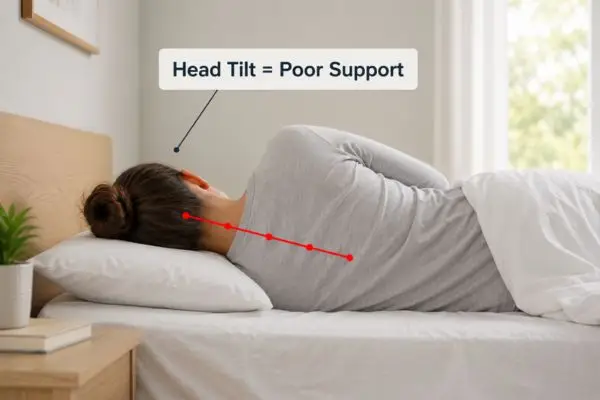
Here’s a simple test:
Lie on your side and have someone take a photo.
Your nose should align with the center of your chest.
If your head drops → pillow too low
If your head angles up → pillow too high
Misalignment = pillow causing neck pain.
4️⃣ You’re Using an Old Pillow
Most pillows last 1–2 years.
Memory foam loses resilience.
Down loses loft.
Polyfill collapses.

I didn’t realize that my 4‑year‑old pillow causing neck pain, had lost almost 40% of its height.
Compression test:
Press firmly in the center.
Does it bounce back fully?
If not, it’s done.
5️⃣ You Get Headaches at the Base of Your Skull
Occipital headaches often start from poor sleep posture.
If your pillow is causing neck pain, compressing the upper cervical spine, tension builds at the base of your skull.
This was my exact symptom.
6️⃣ Your Shoulder Also Hurts (Side Sleepers)
If you’re a side sleeper, pillow height matters more.
Too low → shoulder collapses inward.
Too high → neck bends laterally.
Many times, a pillow causing neck pain also triggers shoulder discomfort.
7️⃣ You Sleep Hot and Toss Frequently
Overheating leads to movement.
Movement causes inconsistent support.
If your pillow is causing neck pain and traps heat, it may be disrupting alignment all night.
Why Pillow Height Is the #1 Culprit
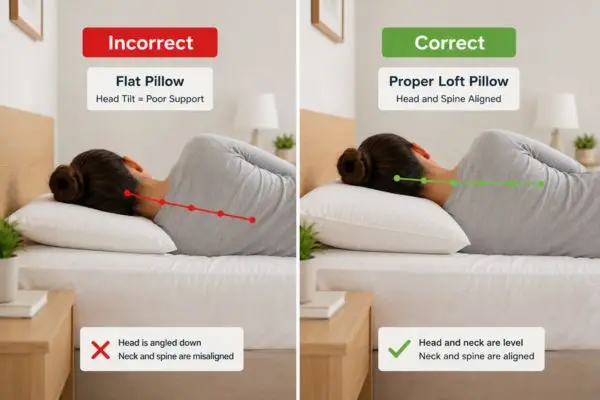
Most people choose pillows based on softness.
But height matters more.
Side sleepers:
Need medium-high to high loft
Back sleepers:
Need medium loft
Stomach sleepers:
Need very low loft
The wrong height is the most common reason for a pillow causing neck pain.
The Mattress Factor (Almost Nobody Mentions This)
Your mattress changes your pillow needs.
Soft mattress:
Shoulder sinks → need a lower pillow
Firm mattress:
Shoulder elevated → need a higher pillow
When I switched mattresses, my pillow causing neck pain, returned — even though it was the same pillow.
That’s when I understood the interaction.
My Honest Pillow Testing Experience
After realizing my pillow was causing neck pain, I tested:
✅ Adjustable shredded memory foam
✅ Solid high-loft foam
✅ Latex
✅ Down
✅ Cooling memory foam
Here’s what I learned:
Down was too inconsistent.
Standard memory foam was too low.
Latex held its shape better.
Adjustable foam gave the most control.
Once I dialed in the proper height, my morning stiffness reduced within one week.
How to Self-Test If Your Pillow Is Causing Neck Pain
Here’s my quick checklist:
✅ Pain worse in the morning, better later
✅ Head not level when lying down
✅ Pillow flattened overnight
✅ Pillow older than 2 years
✅ Frequent fluffing
✅ Shoulder discomfort
If you check 3 or more, your pillow is causing neck pain very likely.
When It’s NOT Just the Pillow
Important:
If you experience:
- Arm numbness
- Tingling
- Persistent pain beyond 7–10 days
- Weakness
Consult a medical professional.
Pillow causing neck pain is common — but not everything is pillow-related.
How to Fix It (What Actually Worked for Me)
- Measured shoulder gap
- Switched to an adjustable high-loft pillow
- Matched pillow height to mattress firmness
- Replace pillow every 18–24 months.
- Stopped prioritizing softness
Within two weeks, the pillow causing neck pain was gone.
✅ FAQ: Pillow Causing Neck Pain
1️⃣ Can a pillow really cause neck pain?
Yes, a pillow causing neck pain is very common. If your pillow is too high, too low, too soft, or too firm, it can misalign your neck and spine for several hours each night. Over time, this strain leads to stiffness, soreness, and even headaches in the morning.
2️⃣ How do I know if my pillow is causing neck pain?
A pillow causing neck pain usually creates symptoms that are worse in the morning and improve during the day. Other signs include constantly adjusting your pillow, folding it in half, or noticing your head tilts upward or downward when lying on your side.
3️⃣ What pillow height prevents neck pain?
The correct height depends on your sleep position and shoulder width. Side sleepers typically need a medium to high loft pillow, while back sleepers need a medium loft. Proper height keeps your head aligned with your spine and reduces the risk of pillow causing neck pain.
4️⃣ How often should I replace my pillow to avoid neck pain?
Most pillows should be replaced every 1–2 years. Over time, materials compress and lose support, increasing the chances of the pillow causing neck pain due to poor alignment overnight.
5️⃣ Is memory foam better if my pillow is causing neck pain?
Memory foam and latex pillows often help because they maintain their shape and provide consistent support. Adjustable memory foam pillows can be especially helpful if your current pillow, which is causing neck pain, lacks proper height.
Final Thoughts
If you’re waking up sore and wondering what’s wrong, don’t overlook the simplest possibility.
Your pillow causing neck pain is more common than people realize.
The good news?
It’s one of the easiest problems to fix.
Measure your alignment.
Choose structure over softness.
Replace old pillows.
Sometimes the solution isn’t complicated.
It’s just better support.