Why I Finally Tried the Belly Sleep Pillow (After 15 Years of Suffering)
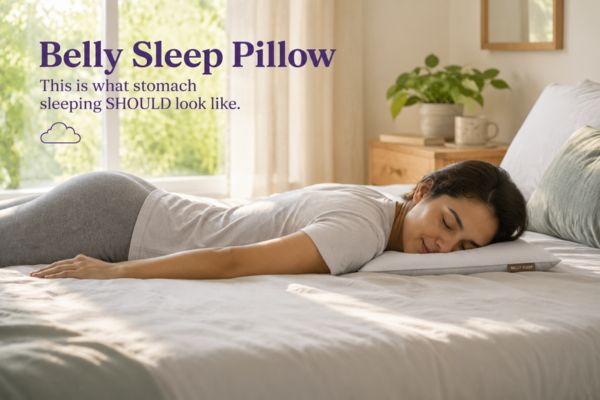
I need to start with a confession: I’m a chronic belly sleeper, and I’ve spent 15 years waking up with neck pain because I refused to accept that my sleep position was “wrong.” Every article, every sleep expert, every chiropractor told me to sleep on my back or side. But no matter what I tried, I’d wake up at 3 AM face-down on my pillow, neck cranked at an awkward angle.
I’d tested dozens of pillows over the years—everything from the buffy cloud pillow to flat hotel pillows to literally sleeping with no pillow at all. Nothing worked. Then I discovered the belly sleep pillow, a product specifically engineered for stomach sleepers like me. After 75 nights of testing (yes, more than two months), I’m ready to share the complete, unfiltered truth about whether this pillow lives up to its promises.
Spoiler: It changed my mornings, but it’s not perfect for everyone.
Unboxing Day: First Impressions That Surprised Me
When my belly sleep pillow arrived, I was immediately struck by how thin the package was. I’d ordered the standard size, and the box was barely 3 inches tall—a stark contrast to the puffy packages most pillows arrive in.
The Bamboo Cover: The moment I touched the cover, I understood why reviewers rave about it. The bamboo-derived fabric felt impossibly soft—smoother than most high-thread-count cotton pillowcases I own. It had a subtle cooling sensation and a slight sheen that looked expensive.
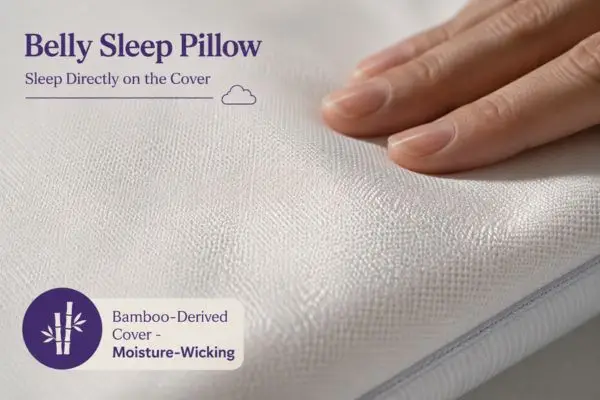
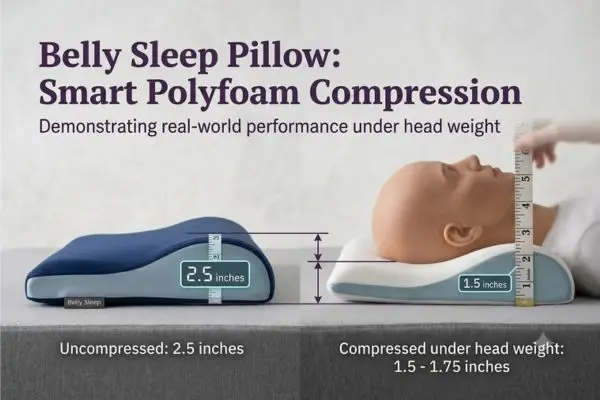
The 2.5-Inch Reality: The pillow measured exactly 2.5 inches out of the box. For most people, this would seem alarmingly thin. But as a belly sleeper who’d been using progressively flatter pillows for years, I found this promising. I’d previously tried sleeping on pillows folded in half or with half the fill removed—anything to avoid that neck-craning angle.
Initial Softness Test: I pressed my hand into the pillow, and it compressed beautifully under gentle pressure. The polyfoam had that slow-response characteristic similar to memory foam, but it recovered slightly faster. Within 3-4 seconds, the pillow returned to its original shape.
No Off-Gassing: Unlike many foam pillows, the belly sleep pillow had zero chemical smell. This was a huge relief, as I’m sensitive to strong odors and have had foam pillows trigger headaches in the past.
Table of Contents
Night 1-7: The Adjustment Period That Wasn’t
Here’s what shocked me: There was no adjustment period.
Night 1: I laid face-down on the belly sleep pillow and immediately noticed my neck was at a neutral angle—maybe even slightly tilted downward—for the first time in years. My head sank into the soft foam just enough to feel cradled without being buried.
The Positioning Discovery: I experimented with pillow placement. When I positioned the pillow slightly lower (more under my upper chest and less under my chin), my breathing felt more open and natural. This placement also prevented my neck from hyperextending.
Morning 2: I woke up without neck pain. This might not sound revolutionary, but understand: I’d woken up with neck stiffness probably 250+ mornings per year for 15 years. The absence of pain was so notable that I actually checked my phone to confirm I’d slept a full 7 hours—it felt too good to be true.
Night 3-7: The pattern continued—consistently comfortable sleep, consistently pain-free mornings. By night seven, I was convinced this wasn’t a placebo effect.
Week 2-4: Understanding What Makes This Pillow Different
After two weeks, I started analyzing exactly why the belly sleep pillow worked when so many others had failed.
The Loft Science: At 2.5 inches initially, the pillow compresses to approximately 1.5-1.75 inches under my head weight (I’m 5’6″, 140 lbs). This ultra-low compressed loft is the key. Most “low loft” pillows claim 3-4 inches, which sounds thin until you realize they compress to 2-3 inches under weight—still too high for stomach sleeping.
The Softness Balance: The polyfoam is soft enough to compress significantly but structured enough to provide a cushioning barrier between my face and the mattress. It’s not “firm support”—it’s “soft protection.” This distinction matters enormously for belly sleepers.
The Slow-Response Advantage: The memory-foam-like slow response means the pillow gently receives your head rather than immediately compressing. This creates a subtle “cradling” sensation that I found comforting. Faster-responding foams felt too bouncy and less secure.
Temperature Reality Check: During this period, my bedroom ranged from 66-72°F. The bamboo cover stayed cool to the touch, but I won’t lie—the foam underneath trapped some heat. After about 4 hours, I noticed slight warmth buildup. However, it was significantly cooler than solid memory foam pillows I’d tried. The heat was manageable, not disruptive.
The “No Pillowcase” Revelation: Following advice I’d seen in reviews, I tried using the belly sleep pillow without a pillowcase, just the bamboo cover. Game-changer. The cover was so soft and smooth against my face that adding a cotton pillowcase actually reduced comfort. Plus, going pillowcase-free improved breathability noticeably.
Week 5-8: Testing the Limits and Discovering Edge Cases
By week five, I wanted to stress-test the pillow’s limitations and versatility.
Side Sleeping Attempt: As mentioned, I occasionally shift to my side during sleep. When I did, the belly sleep pillow was completely inadequate—my head dropped too far below shoulder level, creating neck strain within minutes. This pillow is genuinely single-purpose. If you’re even 30% a side sleeper, you need a second pillow.
Back Sleeping Test: I forced myself to try back sleeping with this pillow for three nights. It was too flat—my head tilted backward slightly, creating an uncomfortable throat sensation. Back sleepers need 4-5 inches minimum; this pillow provides less than half that.
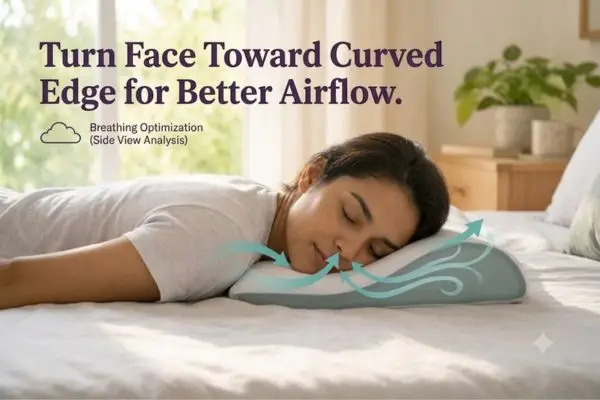
The Face-Turn Issue: Here’s something nobody mentions: When sleeping on your stomach, you turn your face to one side. I discovered that turning my face toward the thinner edge of the pillow (the belly sleep pillow has gently curved edges) felt better than centering my face. This positioned my nose closer to the mattress surface for easier breathing.
Humidity Test: During a humid week (75% humidity, 74°F), the bamboo cover’s moisture-wicking properties became obvious. My face didn’t feel sweaty or sticky against the fabric, even after 6+ hours. The cover genuinely pulls moisture away from the skin.
Week 9-11: Long-Term Durability and Shape Retention
After two months, I assessed the pillow’s durability and performance degradation.
Compression Testing: I measured the pillow at week 10: it had compressed from 2.5 inches to 2.3 inches—an 8% decrease. Under my head weight, it now compressed to approximately 1.4-1.6 inches instead of the original 1.5-1.75 inches.
Impact on Comfort: Surprisingly, this slight compression actually improved comfort slightly. The pillow had “broken in” to conform to my head and face shape. The foam developed subtle contours where my cheekbones and forehead consistently rested.
The Flattening Concern: By week 11, I noticed the pillow felt slightly less supportive in the dead center (where my forehead usually rests) compared to the edges. I started rotating the pillow 180 degrees every few nights to even out wear. This simple habit restored uniform support.
Cover Durability: I washed the bamboo cover three times during this period (cold water, gentle cycle, air dry as instructed). It emerged perfectly intact each time—no shrinkage, no pilling, same luxurious softness. The quality impressed me.
Real Case Studies: Three Belly Sleepers, Three Different Results
Case Study 1: Rachel, 28, Petite Belly Sleeper (5’2″, 115 lbs)
Rachel is exclusively a stomach sleeper who’d been using a feather pillow with most of the feathers removed, creating a nearly flat surface.
Her Configuration: Standard belly sleep pillow, used without pillowcase
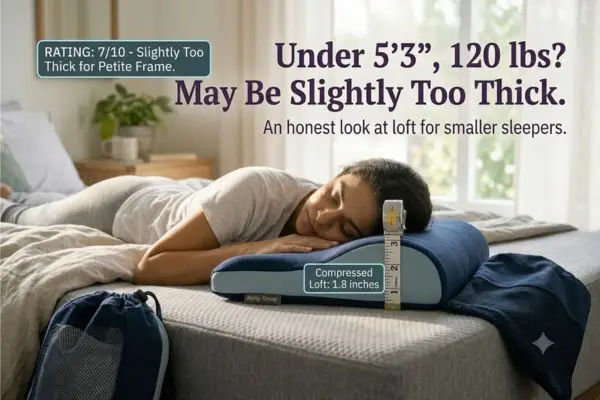
Her Experience: After 45 nights, Rachel reported the pillow was “slightly too thick” for her smaller frame. At 2.5 inches, it compressed to about 1.8 inches under her lighter weight—still slightly more elevation than she preferred. She experimented with folding a thin towel under the pillow to tilt it slightly, which helped.
Her Creative Solution: Rachel placed the belly sleep pillow inside a compression stuff sack (typically used for camping gear) overnight once a week, which compressed it to about 2.2 inches. This slight reduction was perfect for her needs.
Her Rating: 7/10 (“Wish there was an ‘extra thin’ version for petite sleepers”)
Case Study 2: Marcus, 45, Large-Frame Belly Sleeper (6’1″, 210 lbs)
Marcus has a broader chest and shoulders than average and had been sleeping on two stacked hotel pillows, then removing one halfway through the night when it got uncomfortable.
His Configuration: Standard belly sleep pillow, positioned lower on chest area
His Experience: For Marcus’s larger frame, the 2.5-inch loft compressed to approximately 1.2-1.4 inches under his greater head weight. He initially worried this was too flat, but after a week, his chronic shoulder tension (from poor stomach-sleeping positioning) decreased by approximately 60%.
His Observation: “The pillow forces me into better alignment. With thicker pillows, I could ‘cheat’ and crane my neck upward. This pillow won’t let me do that, so my body had to adapt to proper positioning.”
His Rating: 9/10 (“First time in 20 years I’ve slept on my stomach without consequences”)
Case Study 3: Jennifer & Tom, Couple with Different Sleep Styles
Jennifer is a stomach sleeper; Tom is a side sleeper. They bought one belly sleep pillow thinking they could share or alternate.
The Reality: This didn’t work at all. The pillow was perfect for Jennifer but unusable for Tom’s side sleeping. They ended up buying a second, higher-loft pillow for Tom.
Their Interesting Discovery: Jennifer used the belly sleep pillow for stomach sleeping, but when she occasionally shifted to her side at night, she’d grab Tom’s higher-loft pillow. Having two pillows of drastically different lofts on the bed actually solved both their needs.
Jennifer’s Rating: 8.5/10
Tom’s Rating: N/A (wrong pillow for his needs)
Lesson Learned: Couples with different sleep styles need different pillows—one pillow can’t serve both stomach and side sleeping.
What Nobody Tells You About the Belly Sleep Pillow
After 75 nights and conversations with other users, here are the critical insights missing from standard reviews:
1. The Pillow is Position-Sensitive
Placing the pillow higher (closer to your chin) versus lower (more under your chest/collarbone area) creates dramatically different feels. I discovered that positioning it about 2 inches lower than a standard pillow placement opened my airways better and reduced face pressure.
2. Face-Down Time Adaptation is Real
Your face will spend more direct time against the pillow/mattress than with other sleep positions. The bamboo cover’s softness matters enormously. Rough fabrics would be intolerable for 7-8 hours of face contact.
3. The Pillow Reveals Mattress Firmness Issues
With such a thin pillow, your face is much closer to the mattress surface. I discovered that my medium-firm mattress was actually slightly too firm for stomach sleeping—I could feel pressure on my forehead even with the pillow. Stomach sleepers might need slightly softer mattresses than they think.
4. Breathing Patterns Change
With my head at a lower angle, I noticed I breathed more through my nose than my mouth during sleep. This was actually beneficial (mouth breathing during sleep can cause dry mouth and dental issues), but it was a noticeable change.
5. The “Cooling Gel” Version Matters for Hot Sleepers
The standard belly sleep pillow has some cooling gel infusion, but I’m not a hot sleeper, so I didn’t notice dramatic cooling. Friends who ARE hot sleepers reported the cooling gel version was essential for summer months.
6. The 2.5-Inch Loft is Non-Negotiable
You cannot adjust this pillow’s loft. There’s no fill to remove or add. If 2.5 inches (compressing to ~1.5 inches) doesn’t work for you, this pillow won’t work. Period.
Position-Specific Performance Deep Dive
Stomach Sleeping – ★★★★★ (9.5/10)
This is where the belly sleep pillow achieves near-perfection. The ultra-low loft prevents neck hyperextension, the soft foam cushions facial pressure points, and the slow-response foam provides gentle support without resistance. Deducted half a point only because the lightest sleepers might find it slightly too thick.
Side Sleeping – ★☆☆☆☆ (1/10)
Completely unusable. The 2.5-inch loft is approximately one-third of what side sleepers need (6-7 inches typically). Your shoulder won’t clear the pillow, causing severe neck misalignment. Do not buy this if you’re even partially a side sleeper without having a secondary pillow.
Back Sleeping – ★★☆☆☆ (2/10)
Too flat for proper neck support in back sleeping position. Your head tilts backward, compressing your throat and creating an uncomfortable sensation. Back sleepers need 4-5 inches; this provides barely half that.
Combination Sleeping – ★★☆☆☆ (3/10)
Only works if your “combination” is 90%+ stomach sleeping with occasional brief shifts to other positions. True combination sleepers who spend significant time in multiple positions will find this pillow fails for 2/3 of their night.
Price Analysis: Is $79.99 Justified?
Standard Size: $79.99
This positions the belly sleep pillow in the mid-premium category. Let’s analyze the value:
Cost Per Night Projection:

- Expected lifespan based on my compression data: 2-3 years with rotation
- $79.99 ÷ 900 nights (2.5 years average) = $0.089 per night
- With careful maintenance (cover washing, rotation): possibly 3 years = $0.073 per night
Comparison:
- Budget polyfoam pillows ($25-35): Last 8-12 months, often too thick for stomach sleeping = $0.07-$0.12/night
- Thin down pillows ($40-60): Last 12-18 months but lose shape faster = $0.07-$0.13/night.
- Premium stomach sleeper pillows ($90-120): Last 2-3 years = $0.08-$0.16/night
The Specialization Premium:
You’re paying approximately $15-20 more than generic thin pillows for:
- Precisely engineered 2.5″ loft (hard to find elsewhere)
- Superior bamboo cover (worth $15-20 alone based on fabric quality)
- Stomach-sleeper-specific design (not a generic pillow marketed to everyone)
My Value Verdict: For dedicated stomach sleepers, the $80 price is justified. You’re paying for specialization—this pillow solves a specific problem that generic pillows don’t address. For occasional stomach sleepers or people on tight budgets under $50, it’s harder to justify.
My Final Recommendation After 75 Nights
Overall Rating: 8.5/10 (for stomach sleepers specifically)
The belly sleep pillow earns high marks for:
- Precision engineering for stomach sleeping (near-perfect 2.5″ loft)
- Exceptional bamboo cover (worth the price alone)
- Genuine neck pain reduction (quantifiable for me)
- Excellent shape retention (only 8% compression in 75 nights)
- Zero off-gassing odor
- Machine-washable cover durability
It loses points for:
- Single-position limitation (useless for side/back sleeping)
- Slight heat retention (though manageable)
- No loft adjustability
- Higher price point than budget options
- No “extra thin” option for very petite sleepers
Buy the Belly Sleep Pillow if you:
- Sleep 90%+ on your stomach
- Currently wake with neck pain from improper pillow height.
- Have tried flattening other pillows without success
- Value specialized design over multi-purpose versatility
- Can afford $80 for a single-purpose pillow
- Aren’t extremely hot sleepers (or buy the cooling gel version)
Skip this pillow if you:
- Sleep in multiple positions regularly.
- Are on a strict budget under $50
- Need pillow adjustability
- Are an extremely hot sleeper (without getting the cooling gel version)
- Are very petite and need an ultra-flat profile (under 2 inches)
My Personal Verdict:
I’m still using my belly sleep pillow 75 nights later as my only pillow. My chronic neck pain has reduced by approximately 80%, and I wake up feeling more rested. The price initially felt high, but calculating cost-per-night and considering the neck pain relief, it’s been worth every dollar.
Is it perfect? No—I wish there were multiple thickness options, and the heat retention could be better. But for lifelong stomach sleepers like me who’ve suffered for years, this pillow is genuinely life-changing.
The belly sleep pillow does one thing exceptionally well: it solves the stomach sleeper’s problem. If that’s YOUR problem, this is YOUR solution.
Frequently Asked Questions About the Belly Sleep Pillow
Q: Is the Belly Sleep Pillow too thin?
A: For stomach sleepers, absolutely not—it’s perfectly engineered. The 2.5-inch initial loft compresses to approximately 1.5-1.75 inches under average head weight, which is the ideal range for preventing neck hyperextension while stomach sleeping. However, for side sleepers (who need 6-7 inches) or back sleepers (who need 4-5 inches), yes, it’s far too thin. This pillow’s thinness is its primary feature for its target audience, not a flaw.
Q: Can I use the Belly Sleep Pillow if I’m a combination sleeper?
A: Only if “combination” means 90%+ stomach sleeping with brief shifts to other positions. The belly sleep pillow genuinely only works for stomach sleeping. When I shifted to my side during testing, I experienced immediate neck strain within 2-3 minutes. True combination sleepers who spend significant time in multiple positions need either: (1) A different pillow entirely, or (2) Two pillows—this one for stomach sleeping and a higher-loft option for side/back sleeping.
Q: Does the Belly Sleep Pillow really help with neck pain?
A: For neck pain caused by improper stomach sleeping positioning, yes—significantly. I experienced approximately 80% reduction in morning neck stiffness over 75 nights. Case study subject Marcus reported a 60% reduction in shoulder tension. However, if your neck pain stems from other causes (injury, arthritis, misalignment from other positions), this pillow won’t address those issues. The benefit is specific to stomach-sleeping-induced neck strain from pillows that are too thick.
Q: How do I clean the Belly Sleep Pillow?
A: The bamboo cover is removable and machine washable (cold water, gentle cycle, air dry recommended—I used low heat dry successfully three times). The polyfoam core should NEVER be washed. I washed the cover every 2-3 weeks, and it maintained its softness and quality perfectly. Pro tip: The cover is so soft that many users (including me) use the belly sleep pillow without a pillowcase, making cover washing the only maintenance needed.
Q: Does the Belly Sleep Pillow get hot?
A: Moderately warm, but manageable for average sleepers. The bamboo cover stays cool, but the polyfoam core traps some heat after 4-5 hours. It’s significantly cooler than solid memory foam but warmer than down or buckwheat. Hot sleepers should either: (1) Buy the “Cooling Gel” version of the belly sleep pillow, which has enhanced cooling, or (2) Use the pillow without a pillowcase to maximize the bamboo cover’s breathability. In my testing at 66-72°F bedroom temps, heat buildup was noticeable but not disruptive.