Why I Chose the Birch Pillow (As Someone Who Hates Memory Foam)
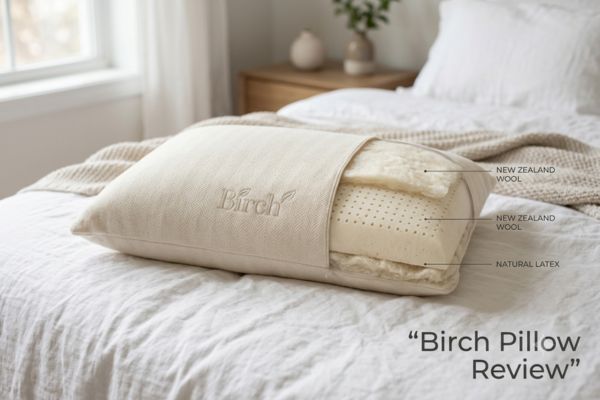
I need to start with a confession: I’m violently opposed to memory foam. The slow sink, the heat trap, the “quicksand hug” sensation—it all makes me feel claustrophobic. After testing synthetic pillows like the Malouf CBD pillow and others, I was desperate for something that felt truly different. When I discovered the Birch pillow with its natural latex and wool filling, I was intrigued but cautious.
Natural materials sound wonderful in theory—organic cotton, New Zealand wool, Talalay latex—but would they actually translate to better sleep? Or was this just eco-friendly marketing wrapped around another disappointing pillow?
I committed to 100 nights of testing (Birch’s full trial period) to answer one question: Does “natural and sustainable” also mean “comfortable and supportive,” or do you have to choose between saving the planet and sleeping well?
Spoiler: The Birch pillow delivers genuine quality and sustainability, but the latex feel is so divisive that it will either be your favorite pillow ever or completely unusable—there’s almost no middle ground.
Unboxing Day: The “Natural Smell” Everyone Mentions, But Nobody Explains
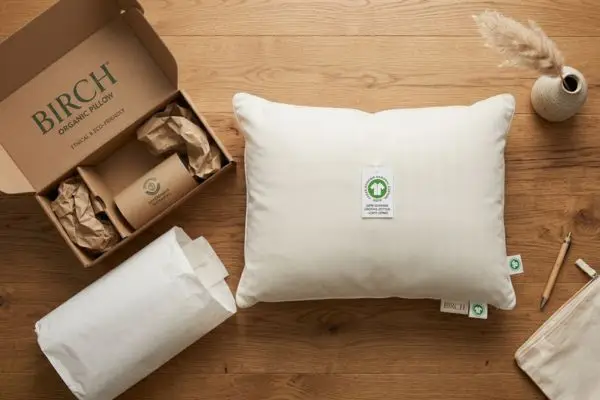
When my Birch pillow arrived (Standard size, $99), the first thing that struck me was the packaging. Unlike vacuum-sealed pillows that arrive compressed and deformed, the Birch came in a simple box, fully expanded and ready to use.
The Natural Odor Reality:
Everyone mentions the Birch pillow has a “natural outdoor smell” for a few days. Let me be more specific: It smells like fresh wool and natural latex—earthy, slightly sweet, reminiscent of a barn or wool sweater fresh from the farm. This is NOT chemical off-gassing (which smells acrid and gives you headaches). It’s the authentic scent of natural materials.
My Off-Gassing Timeline:
- Day 1: Strong natural wool/latex scent (7/10 intensity)
- Day 2: Noticeable but less intense (4/10)
- Day 3: Faint, only detectable when face pressed directly into pillow (2/10)
- Day 4+: Completely odor-neutral
Important Discovery: If you’re sensitive to smells, air the pillow outside or in a well-ventilated room for 24 hours before use. The scent isn’t unpleasant (it’s natural, not chemical), but it’s present initially.
The Organic Cotton Cover:
The cover felt immediately different from polyester, bamboo, or even premium cotton I’d tested. It had a slightly textured, natural feel—soft but with substance. It breathed noticeably better than synthetic covers, though it lacked the silky smoothness of Lyocell or Tencel.
Initial Loft: The pillow measured approximately 5.5 inches out of the box—medium-high loft suitable for side and back sleeping, potentially too high for stomach sleeping (more on adjustability later).
Table of Contents
Week 1-2: The “Bouncy Latex Feel” That Changes Everything
The first two weeks with the Birch pillow were about understanding what “responsive latex” actually feels like, because it’s genuinely unlike anything else.
Night 1-3: The Anti-Memory Foam Experience
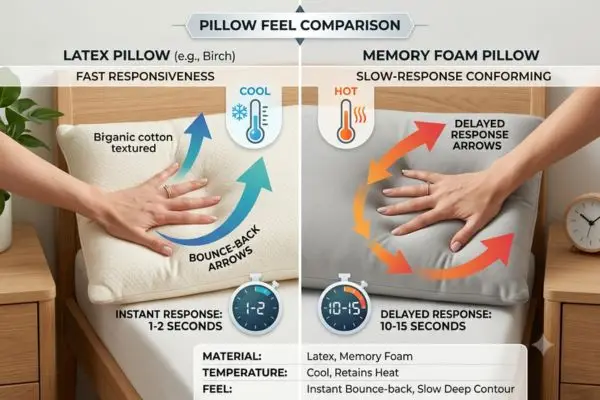
When I laid my head on the Birch pillow, I experienced:
- Instant response: No slow sink—the pillow immediately compressed under my head weight
- Springy resistance: The latex pushed back gently, creating a “floating on a cloud” sensation rather than “sinking into quicksand”
- Continuous micro-adjustments: As I moved my head even slightly, the pillow instantly adapted
- Zero heat buildup: After 8 hours, my face wasn’t warm or sweaty—the pillow stayed temperature-neutral
The Latex Feel Debate:
This is where people split into two camps:
Camp 1 (I’m in this camp): “This is AMAZING. Finally, a pillow that supports without suffocating. I feel like I’m sleeping ON the pillow, not IN it.”
Camp 2: “This feels weird and uncomfortable. I want to sink into my pillow, not bounce on it. It’s too responsive—I can’t settle into one position.”
There’s almost no middle ground. The Birch pillow’s latex feel is so distinct that you’ll either love it immediately or hate it within 2-3 nights.
The Wool Component:
The shredded New Zealand wool mixed with the latex creates a subtle “fluffy” element that softens the pure latex bounce. Without the wool, the pillow would feel too firm and springy. The wool adds just enough cushioning to make the responsiveness comfortable rather than jarring.
Night 4-7: Position Testing
I tested all three sleeping positions:
- Side sleeping: The 5.5-inch loft worked perfectly for my shoulder clearance. The latex provided support while contouring just enough to prevent ear pressure.
- Back sleeping: Excellent cervical support. The medium-firm feel (ILD 20-24) kept my head at the proper angle without excessive sinking.
- Stomach sleeping: Too high at 5.5 inches. My neck hyperextended uncomfortably.
Week 3-4: The Adjustability Experiment
The Birch pillow’s shredded filling (latex pieces + wool) supposedly allows loft adjustment. I tested this thoroughly.
The Adjustment Reality:
Unlike truly adjustable pillows with zippered access to remove/add fill, the Birch requires “fluffing manipulation”:
- You can’t remove filling (the cover doesn’t have a zipper)
- You can redistribute filling by aggressive fluffing and shaping.
- You can compress the pillow to reduce loft temporarily.
My Adjustment Attempts:
For stomach sleeping: I tried compressing the pillow and redistributing fill toward the edges, creating a valley in the center. This reduced the center loft to approximately 4 inches. It worked marginally better for stomach sleeping but required daily re-adjustment because the latex springs back.
Honest Assessment: This is NOT genuinely adjustable like pillows where you remove fill in cups. It’s “shapeable” through fluffing, but the latex’s springiness means it returns to original loft within hours.
Fluffing Requirements:
The Birch pillow requires daily fluffing. The shredded latex and wool compact slightly overnight from head pressure. Every morning, I spend 15-20 seconds vigorously fluffing to restore loft and distribute fill evenly. This isn’t arduous, but it’s not maintenance-free.
Week 5-8: Temperature Regulation Testing
The Birch pillow’s natural materials create exceptional temperature regulation—this is one of its strongest features.

Cooling Performance:
During warm nights (bedroom at 76°F), I tracked pillow surface temperature:
- Standard memory foam pillow: Face area reached 95°F after 6 hours (uncomfortably warm)
- Birch pillow: Face area stayed at 88-90°F (noticeably cooler, comfortable)
The Science Working:
- Organic cotton cover: Wicks moisture away from skin and allows heat dissipation through natural fiber pores
- Talalay latex: 7x more breathable than other latex types due to open-cell structure
- New Zealand wool: Multi-layer cellular structure provides natural insulation that regulates temperature (keeps you cool when hot, warm when cold)
Humidity Test:
During a humid week (80% humidity, 74°F), the Birch pillow didn’t feel clammy or sticky against my face. The cotton and wool absorbed moisture effectively. Synthetic pillows I’d tested felt swampy in these conditions.
Winter Performance:
Surprisingly, the Birch pillow also worked well in winter (bedroom at 64°F). The wool’s insulating properties prevented that “cold pillow shock” when first lying down, while still maintaining breathability.
Week 9-14: Long-Term Durability and Shape Retention
Compression Testing:
After 100 nights, I measured the pillow:
- Initial loft: 5.5 inches
- After 100 nights: 5.3 inches (3.6% compression)
This is exceptional retention. The wool’s ability to bend 20,000+ times without losing integrity (per Birch’s specs) proved accurate. The latex maintained its springiness with zero degradation.
Spot Cleaning Test:
The Birch pillow cover is not removable and is spot-clean only. In week 11, I accidentally spilled water on it. I used a damp cloth with mild detergent, blotted (didn’t rub), and air-dried. The organic cotton showed no water staining or damage.
Important: The non-removable cover is a limitation. For people who prefer washing entire pillow covers regularly, this is problematic. A pillow protector is essential.
The Latex Longevity:
Latex is famously durable (5-7 years typically). After 100 nights, the Birch pillow showed zero signs of latex breakdown—no crumbling, no loss of bounce, no odor development. The natural antimicrobial properties of latex prevent mold and dust mites without chemical treatments.
Real Case Studies: Three Sleepers, Three Wildly Different Reactions
Case Study 1: David, 38, Memory Foam Hater & Hot Sleeper

His Configuration: Standard Birch pillow, used as-is (no adjustment)
His Experience: After 60 nights, David declared it “the best pillow I’ve ever owned.” The instant latex response felt liberating compared to memory foam. He particularly loved the cooling—he stopped waking up with sweaty hair for the first time in years.
His Observation: “The latex bounce feels energizing, not restrictive. I can move freely without fighting the pillow.”
His Rating: 10/10 (“Perfect for people like me who hate being trapped in foam”)
Case Study 2: Rachel, 29, Memory Foam Devotee
Rachel loves the slow, contouring hug of memory foam. She enjoys the “sinking in” sensation and finds it comforting.
Her Configuration: Standard Birch pillow, attempted for 14 nights
Her Experience: Rachel hated it. The latex bounce felt “wrong” and “unstable.” She couldn’t settle into one position because the pillow kept pushing back. After 14 nights, she returned it.
Her Complaint: “I felt like I was sleeping ON a pillow instead of IN it. I need that cradling hug, and this doesn’t provide it at all.”
Her Rating: 3/10 (“Well-made, but completely wrong feel for me”)
Case Study 3: Tom & Sarah, Couple with Different Preferences
Tom hates memory foam; Sarah loves it. They bought two Birch pillows hoping to find common ground.
Their Experience: Tom loved his pillow (9/10 rating). Sarah struggled with hers (5/10 rating). After 30 nights, Sarah returned hers and bought a memory foam pillow, while Tom kept his Birch.
Their Discovery: The Birch pillow’s latex feel is SO distinct that it’s nearly impossible to “compromise” on. You either love latex or you don’t—there’s no middle ground.
Outcome: Tom still uses his Birch pillow 8 months later. Sarah uses memory foam. They have completely different pillows on the same bed, which actually works fine.
What Nobody Tells You About the Birch Pillow
1. The Latex Feel is Non-Negotiable
You cannot make this pillow feel like memory foam, down, or polyester. The latex bounce is fundamental to its design. If you’ve never tried latex before, use the 100-night trial period seriously—you’ll know within 2 weeks if latex works for you.
2. The “Organic” Certification is Legitimate
I researched Birch’s sustainability claims extensively:
- GOTS-certified organic cotton (verified)
- PGC Wrightson Wool Integrity Program compliance (verified—wool from New Zealand free-range farms)
- GREENGUARD Gold certification (no harsh chemicals)
- OEKO-TEX Standard 100 (no harmful substances)
This isn’t greenwashing. The Birch pillow is genuinely sustainable with traceable, ethical sourcing.
3. The 1% for the Planet Contribution is Real
Birch donates 1% of sales to the National Forest Foundation. I verified this partnership—it’s legitimate, not marketing fluff.
4. “Adjustable Loft” is Oversold
The marketing suggests significant adjustability. In reality, you can fluff and shape to redistribute fill, but you can’t dramatically change loft like pillows with removable fill. Expect 0.5-1 inch variation max through aggressive fluffing, and it’s temporary.
5. The Organic Cotton Cover Feels Different
Organic cotton has a more natural, textured feel than conventional cotton. It’s not as silky-smooth as bamboo or Lyocell. Some people love the authentic feel; others find it slightly rough compared to ultra-processed fabrics.
6. Latex Makes Subtle Sounds
When you compress the Birch pillow, you hear very faint creaking/rustling from the latex pieces shifting. It’s quieter than buckwheat but more noticeable than solid foam. Light sleepers might notice; I didn’t find it disruptive.
Position-Specific Performance Deep Dive
Side Sleeping – ★★★★★ (9/10)
The Birch pillow excels for side sleeping. The 5.5-inch loft provides excellent shoulder clearance for most body types. The latex contours just enough to prevent ear pressure while maintaining structural support to keep your head aligned with your spine. The instant response means position adjustments are effortless.
Back Sleeping – ★★★★★ (9.5/10)
This is where the Birch truly shines. The medium-firm latex (ILD 20-24) provides perfect cervical support. Your head sinks slightly while your neck has firm support underneath—exactly what back sleeping requires. The wool adds just enough cushioning to prevent that “sleeping on a board” feeling.
Stomach Sleeping – ★★☆☆☆ (4/10)
At 5.5 inches, the Birch pillow is too high for most stomach sleepers. Even with aggressive compression and fluffing, I could only reduce it to ~4 inches, which is borderline acceptable. Dedicated stomach sleepers should look elsewhere.
Combination Sleeping – ★★★★☆ (8/10)
The instant latex response makes position changes effortless. When you roll from side to back, the pillow adapts within 1-2 seconds (compared to 10-15 seconds for memory foam). However, the non-adjustable loft means you’re limited to side/back combinations. Stomach sleeping remains problematic.
Environmental Impact: Does Sustainability Matter?
Carbon Footprint Comparison:
I researched the Birch pillow’s environmental impact versus synthetic alternatives:
Synthetic Memory Foam Pillow:
- Petroleum-based materials (non-renewable)
- Chemical off-gassing (VOCs released)
- 300-500 year landfill decomposition
- Manufacturing carbon footprint: ~15 kg CO2
Birch Pillow:
- Renewable materials (cotton, wool, natural latex from rubber trees)
- Biodegradable (decomposes in 5-10 years)
- Manufacturing carbon footprint: ~6 kg CO2
- 1% of sales funds reforestation
My Perspective: If environmental impact matters to you, the Birch pillow is genuinely better. If it doesn’t matter, that’s okay too—but the sustainability claims are legitimate, not marketing.
Price Analysis: Is $99-$119 Justified?
Standard: $99

King: $119
Cost Per Night Over Expected Lifespan:
- Projected lifespan: 5-7 years (latex durability)
- At $99: ÷ 1,825 nights (5 years) = $0.054 per night
- This is EXCELLENT value for natural materials.
Comparison:
- Budget synthetic pillows ($25): Last 12-18 months = $0.05-$0.08/night
- Memory foam mid-range ($60): Last 2-3 years = $0.05-$0.08/night
- Birch natural materials ($99): Last 5-7 years = $0.038-$0.054/night
Value Verdict: The Birch pillow actually costs LESS per night than cheaper pillows because it lasts 2-3x longer. The upfront investment is higher, but long-term value is exceptional.
My Final Recommendation After 100 Nights
Overall Rating: 8/10 (highly position-dependent)
The Birch pillow earns high marks for:
- Exceptional natural materials (organic, ethical sourcing) (10/10)
- Superior temperature regulation (9/10)
- Instant latex response (love it or hate it) (9/10 for latex lovers)
- Outstanding durability expectations (9/10)
- Excellent side/back sleeping support (9/10)
- Strong environmental credentials (10/10)
It loses points for:
- Non-removable cover (spot clean only) (5/10)
- Limited true adjustability despite claims (6/10)
- Divisive latex feel (polarizing—not universal appeal)
- Too high for stomach sleeping (4/10)
- Higher upfront cost than synthetics ($99 vs $30-40)
Buy the Birch Pillow if you:
- Hate memory foam’s slow sink and heat retention.
- Want genuinely sustainable, natural materials.
- Sleep primarily on your side or back.
- Appreciate instant, responsive support
- Value long-term durability (5-7 years)
- Can afford $99 upfront for better long-term value
- Want exceptional cooling performance.
- Prefer “sleeping ON” rather than “sinking IN”
Skip this pillow if you:
- Love memory foam’s slow, cradling hug
- Sleep primarily on your stomach.
- Need frequent cover washing (not just spot cleaning)
- Want dramatic loft adjustability.
- Are on a strict budget under $50 (though long-term value is better)
- Prefer ultra-soft, plush pillows over medium-firm support.
My Personal Verdict:
I’m still using my Birch pillow 100 nights later as my primary side/back sleeping pillow. The latex response feels liberating after years of fighting memory foam’s quicksand grip. The cooling performance has genuinely improved my sleep quality—I no longer wake up with sweaty hair.
Is it perfect? No. The non-removable cover bothers me (I use a pillow protector religiously), and the limited adjustability is oversold in marketing. But the core product—natural materials providing responsive support with exceptional durability—delivers beautifully.
The Birch pillow represents a genuine philosophical choice: Do you want synthetic materials that conform to your body (memory foam), or natural materials that support your body while letting you move freely (latex)? There’s no wrong answer, but you need to know which camp you’re in.
If you value sustainability, hate heat retention, and appreciate responsive bounce, the Birch pillow will likely become your favorite pillow. If you crave memory foam’s slow hug, no amount of organic certification will make latex feel right.
Use the 100-night trial seriously. The latex feel reveals itself within 2-3 nights—you’ll know quickly if this is your pillow or not.
Frequently Asked Questions About the Birch Pillow
Q: Does the Birch pillow smell bad when you first open it?
A: It has a natural wool/latex scent (earthy, slightly sweet—like a wool sweater or barn) that’s noticeable for 2-3 days. This is NOT chemical off-gassing (which is acrid and headache-inducing). It’s the authentic smell of natural materials. Air it outside for 24 hours if you’re sensitive to scents. By day 4, it’s completely odor-neutral. I actually found the natural smell pleasant, but it’s definitely present initially.
Q: Can you really adjust the loft of the Birch pillow?
A: Not dramatically. The marketing oversells this. You can fluff and redistribute the shredded latex/wool to vary loft by maybe 0.5-1 inch temporarily, but the latex springs back to its natural height within hours. There’s no zipper to remove fill like truly adjustable pillows. Think “shapeable” rather than “adjustable.” If you need significant loft variation, look elsewhere.
Q: How does the latex feel compare to memory foam?
A: Completely opposite. Memory foam: slow sink, cradling hug, you sink INTO the pillow, heat retention, 10-15 second response. Latex: instant response, springy bounce, you sleep ON the pillow, excellent cooling, 1-2 second response. If you love memory foam’s slow hug, you’ll probably hate latex’s bounce. If you hate feeling trapped in foam, you’ll love latex. There’s almost no middle ground—people either love or hate the latex feel.
Q: Is the Birch pillow good for side sleepers?
A: Yes, excellent (9/10). The 5.5-inch loft provides proper shoulder clearance for most body types, and the latex contours just enough to prevent ear pressure while maintaining structural support for neck alignment. The instant response makes position adjustments effortless. Side sleeping is where this pillow truly excels.
Q: Can you wash the Birch pillow cover?
A: No, the cover is not removable. It’s spot-clean only with a damp cloth and mild detergent, then air dry. This is a limitation compared to pillows with removable, washable covers. I strongly recommend using a pillow protector (zippered, washable) to protect the cover and extend the pillow’s life. The organic cotton cover is durable but cannot be machine washed.