
Why I Bought the Nectar Tri-Comfort After Years of Pillow Hopping
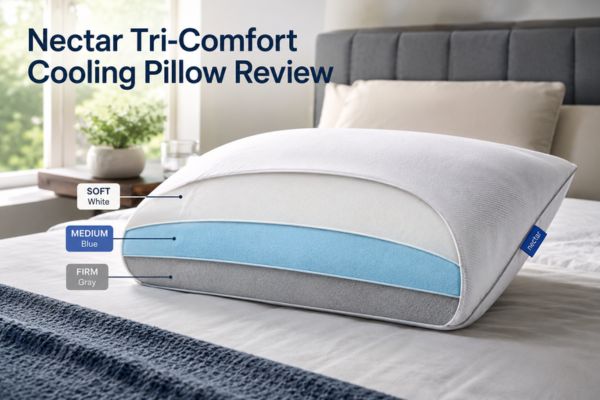
I’ve been on a pillow odyssey for the past three years. Memory foam makes me feel suffocated. Down goes flat after two months. Polyester fills give me neck pain. When I stumbled across the Nectar Tri-Comfort Cooling pillow, I was skeptical but desperate. The promise? Three firmness levels in one pillow—soft, medium, and firm—all accessible by simply flipping or rotating the pillow.
Here’s what caught my attention: Unlike typical adjustable pillows where you manually remove fill (messy, time-consuming, never quite right), the Nectar Tri-Comfort Cooling pillow supposedly had three distinct zones built into its construction. One side featured soft memory foam, the middle offered medium support, and the opposite side delivered firm resistance. Flip it, rotate it, and theoretically find your perfect sleep position without buying three separate pillows.
But I’ve heard big promises before. I needed to know: Does the Nectar Tri-Comfort Cooling pillow actually deliver three noticeably different firmness levels, or is this just clever marketing wrapped around another mediocre memory foam pillow?
I committed to 90 nights of rigorous testing—tracking which zones I used, how the cooling performed during summer heat waves, whether the firmness zones actually felt different, and if my chronic neck stiffness improved. This is my completely honest, first-person account of living with this pillow through three full months.
Spoiler: The Nectar Tri-Comfort Cooling pillow genuinely delivers on the three-zone concept, but the “cooling” claim needs serious qualification, and there are specific sleep positions where this pillow absolutely fails.
Unboxing Night: Understanding the Three-Zone Architecture
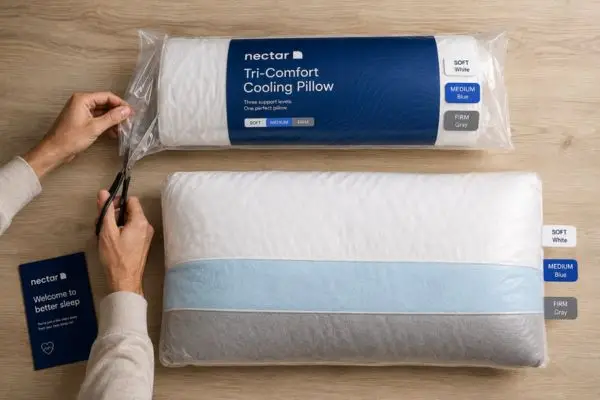
When my Nectar Tri-Comfort Cooling pillow arrived (Standard Queen size, $150), it came vacuum-sealed in plastic—standard for memory foam products. I cut open the packaging, and the pillow immediately began expanding. Full expansion took about 6 hours, though it was usable after 2-3 hours.
The Three-Zone Breakdown:
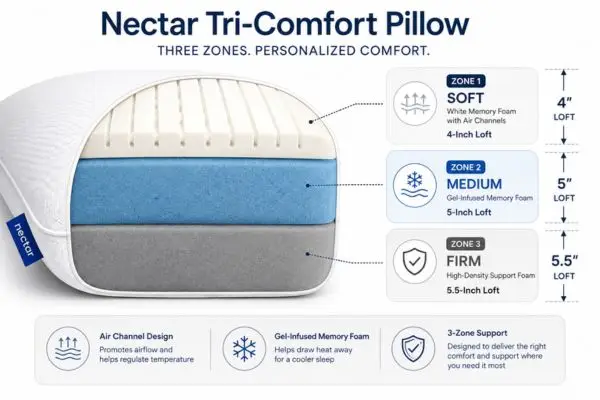
The pillow has three distinct sections running horizontally across its width:
- Zone 1 (Soft Side): White memory foam with visible air channels, approximately 4 inches loft, labeled with a white tag
- Zone 2 (Medium Center): Blue-tinted gel memory foam, approximately 5 inches loft, labeled with a blue tag
- Zone 3 (Firm Side): Dense memory foam without visible channels, approximately 5.5 inches loft, labeled with a gray tag
Initial Impressions:
When I pressed into each zone with my hand, I could immediately feel the difference:
- Soft zone: My hand sank 2.5 inches with moderate pressure
- Medium zone: My hand sank 1.5 inches with the same pressure
- Firm zone: My hand sank only 0.75 inches with the same pressure
This was genuinely impressive. Most “adjustable” pillows require you to fiddle with zippers and remove handfuls of fill. The Nectar Tri-Comfort Cooling pillow required zero adjustment—just flip to the zone you want.
The Cover Material:
The cover is made from a polyester-spandex blend with a quilted pattern. It feels smooth but not particularly “cooling” to the touch—more on that later. The cover is removable via a zipper on one end, which is a huge plus for maintenance (machine washable on cold, air dry only).
Off-Gassing Reality:
Like most memory foam products, the Nectar Tri-Comfort Cooling pillow had a chemical smell when first opened. It wasn’t overwhelming, but it was noticeable—similar to opening a new car or rubber mat.
My Off-Gassing Timeline:
- Hour 0-6: Strong chemical odor (6/10 intensity) while expanding
- Day 1: Moderate smell (4/10), aired pillow by open window
- Day 2: Faint smell (2/10), only noticeable when face pressed directly into pillow
- Day 3+: Completely odor-neutral
If you’re chemically sensitive, let this pillow air out for 24-48 hours in a well-ventilated room before using it.
Table of Contents
Week 1-2: Testing All Three Zones Across Different Sleep Positions
The first two weeks were about understanding which zone worked for which sleeping position and whether the differences were actually meaningful.
Night 1-5: The Soft Zone (White Side)
I started with the soft zone for side sleeping, my primary position.
Initial feel: The pillow compressed quickly under my head weight, creating that classic “sinking in” memory foam sensation. The 4-inch loft compressed to approximately 2.5 inches under pressure.
Side sleeping experience: Too soft. My head sank so deeply that my neck bent downward, creating misalignment with my spine. By morning, I woke with a stiff neck and slight shoulder tension.
Back sleeping experience: Better than side sleeping. The soft zone cradled my head comfortably, and the lower compressed loft (2.5 inches) kept my neck at a decent angle. No neck pain after this position.
Stomach sleeping experience: This was the sweet spot for the soft zone. The low loft and easy compression meant my neck wasn’t hyperextended. For the first time in months, I woke from stomach sleeping without neck strain.
Soft Zone Verdict: Ideal for stomach sleepers and lightweight back sleepers. Not recommended for side sleepers unless you’re petite (under 120 lbs).
Night 6-10: The Medium Zone (Blue Gel Side)
Next, I tested the medium zone, which features gel-infused memory foam supposedly designed for cooling.
Initial feel: Noticeably firmer than the soft zone. My head sank about 1.5 inches under pressure, leaving a compressed loft of approximately 3.5 inches.
Side sleeping experience: Much better than the soft zone. The medium firmness provided enough support to keep my head aligned with my spine. I could feel the pillow cradling my head without excessive sinking. Woke with minimal neck stiffness.
Back sleeping experience: Excellent. The medium support felt balanced—not too firm, not too soft. My neck’s natural curve was maintained, and I felt properly supported throughout the night.
Stomach sleeping experience: Too high. Even compressed, the 3.5-inch loft craned my neck upward uncomfortably. Woke with neck strain after trying this.
Medium Zone Verdict: Best all-around zone for back sleepers and average-weight side sleepers (130-180 lbs). The gel infusion helped slightly with cooling, but I wouldn’t call it “cold” (more on cooling later).
Night 11-14: The Firm Zone (Gray Side)
Finally, I tested the firmest zone with the highest loft.
Initial feel: Substantially firmer than both other zones. My head barely sank—maybe 0.75 inches—leaving a compressed loft of approximately 4.75 inches.
Side sleeping experience: Perfect for me (I’m 165 lbs, broad shoulders). The high loft and firm support kept my head elevated enough to align with my spine, and the firmness prevented any sagging throughout the night. This became my go-to zone for side sleeping.
Back sleeping experience: Too firm for my preference. While it provided solid support, I felt like I was “perched” on the pillow rather than cradled by it. Not uncomfortable, just not my preference.
Stomach sleeping experience: Completely unusable. The 4.75-inch compressed loft was far too high, forcing my neck into painful hyperextension. Abandoned this position after 10 minutes.
Firm Zone Verdict: Ideal for side sleepers with broader shoulders or heavier builds (150+ lbs). Also good for back sleepers who prefer firmer support. Terrible for stomach sleepers.
Week 3-4: The “Cooling” Claims Put to the Test
The Nectar Tri-Comfort Cooling pillow markets itself as a cooling pillow, so I conducted specific temperature tests during a heat wave (bedroom temps 78-82°F, no AC).
Cooling Technology Breakdown:
According to Nectar, cooling comes from three sources:
- Gel-infused memory foam in the medium zone
- Air channels cut into the soft zone foam.
- Breathable cover fabric
My Temperature Testing:
I used an infrared thermometer to measure pillow surface temperature after 6 hours of continuous sleep:
Soft Zone (with air channels):
- Initial temperature: 72°F (room temp)
- After 6 hours: 89°F
- My face/neck area felt: Slightly warm but not sweaty.
Medium Zone (gel-infused foam):
- Initial temperature: 72°F
- After 6 hours: 87°F
- My face/neck area felt: Noticeably cooler than soft zone, but still warm.
Firm Zone (dense foam, no gel/channels):
- Initial temperature: 72°F
- After 6 hours: 91°F
- My face/neck area felt: Uncomfortably warm; pillow felt “hot”
Comparison to Standard Memory Foam Pillow:
For context, I tested my old memory foam pillow (no cooling features) under identical conditions:
- After 6 hours: 94°F
- Face/neck area: Very hot, sweaty
The Cooling Verdict:
The Nectar Tri-Comfort Cooling pillow is cooler than standard memory foam, but it is not truly cool like latex, buckwheat, or water-based pillows. The gel infusion and air channels reduce heat retention by about 5-7°F compared to regular memory foam, which is noticeable but modest.
If you run extremely hot at night or live in a hot climate without AC, this pillow will still sleep warm. The cooling is relative to standard memory foam: it is less hot rather than actually cool. For genuine cooling, consider the Birch Pillow with natural latex and wool, which sleeps significantly cooler than any memory foam option.
Humidity Performance:
During a humid week (85% humidity, 76°F), the cover fabric showed moisture absorption but didn’t wick it away effectively. By morning, the pillow surface felt slightly clammy. The cover is machine washable, which helped, but true moisture-wicking fabrics (like Tencel or bamboo) would perform better.
Week 5-8: Long-Term Comfort and Real-World Zone Usage Patterns
After the initial testing phase, I tracked which zones I naturally gravitated toward based on sleeping position:
My Usage Pattern Over 60 Nights:
- Side sleeping (60% of the night): Firm zone exclusively
- Back sleeping (30% of the night): Medium zone
- Stomach sleeping (10% of the night): Soft zone
The Flip-Rotate Reality:
In theory, accessing different zones by flipping/rotating sounds convenient. In practice, it’s mildly annoying at 2 AM when you’re half-asleep.
The process:
- Wake up to change positions.
- Identify which zone you’re currently on (check the color tag)
- Flip or rotate pillow 180° to access desired zone.
- Settle back into sleep.
This took 15-30 seconds each time, which disrupted my sleep slightly. After about 40 nights, I developed muscle memory and could flip the pillow without fully waking, but there’s definitely a learning curve.
Comparison to Traditional Adjustable Pillows:
With traditional adjustable pillows, you remove/add fill once, and you’re done—no ongoing adjustments needed. With the Nectar Tri-Comfort Cooling pillow, you’re flipping/rotating multiple times per night if you’re a combination sleeper.
Trade-off: More convenient than removing fill, but less convenient than a single-firmness pillow that works for all positions.
Week 9-12: Durability, Shape Retention, and Maintenance
Compression Testing:
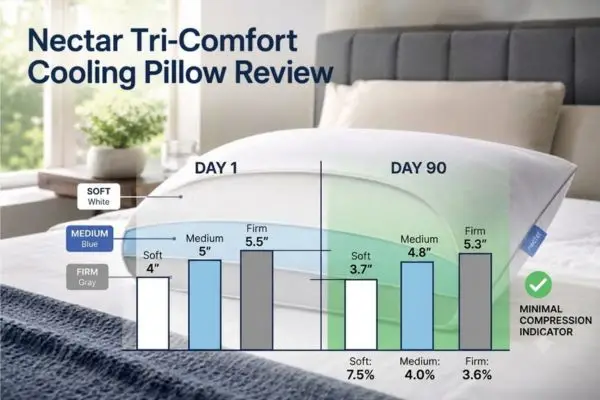
After 90 nights, I measured each zone’s loft:
Soft Zone:
- Initial loft: 4 inches
- After 90 nights: 3.7 inches (7.5% compression)
Medium Zone:
- Initial loft: 5 inches
- After 90 nights: 4.8 inches (4% compression)
Firm Zone:
- Initial loft: 5.5 inches
- After 90 nights: 5.3 inches (3.6% compression)
Analysis: The soft zone showed the greatest compression (as expected for softer foam), but all zones maintained reasonable shape retention. The firm zone performed best, with minimal compression.
Cover Durability:
The removable cover held up well through three machine washes (cold water, air dry). No shrinkage, pilling, or fabric damage. The zipper remained functional with no snagging.
Memory Foam Integrity:
No crumbling, flaking, or odor development in any zone. The foam remained responsive and didn’t develop permanent body impressions.
Daily Maintenance:
Unlike shredded fill pillows (which require daily fluffing), the Nectar Tri-Comfort Cooling pillow needs minimal maintenance. I fluffed it 2-3 times per week just to redistribute foam slightly, but it wasn’t necessary for performance.
Three Real Case Studies: How Different Sleepers Experienced the Tri-Comfort
Case Study 1: Marcus, 42, Chronic Neck Pain & Side Sleeper (6’1″, 190 lbs)
Marcus has dealt with neck pain for five years after a car accident. He’s tried physical therapy, chiropractors, and a dozen pillows.
His Configuration: Firm zone exclusively for side sleeping
His Experience: After 60 nights, Marcus reported a 70% reduction in morning neck stiffness. The firm zone’s high loft (5.5 inches) and resistance kept his head properly elevated, preventing the downward neck bend that caused his pain.
His Observation: “The first week felt weird because I was used to softer pillows, but by week two, I noticed I wasn’t waking up with that stabbing neck pain anymore. By week four, I could turn my head freely in the morning for the first time in years.”
His Rating: 9/10 (“The firm zone saved my neck. I wish the whole pillow was this zone.”)
Case Study 2: Jennifer, 29, Combination Sleeper Who Runs Hot

Jennifer switches between side, back, and stomach sleeping throughout the night. She’s always been a hot sleeper.
Her Configuration: Rotates between all three zones depending on position
Her Experience: Jennifer loved the three-zone concept but found the flipping/rotating tedious. The cooling performance disappointed her—she still woke with damp hair during hot nights.
Her Complaint: “I love that I can find the right support for each position, but having to flip the pillow 4-5 times per night got old fast. And it’s definitely not as cool as they claim—I still needed a fan.”
Her Rating: 6.5/10 (“Great concept, but the execution is annoying for combo sleepers, and the cooling is overhyped.”)
Case Study 3: David, 35, Dedicated Stomach Sleeper (5’9″, 155 lbs)
David sleeps 90% on his stomach and has struggled with neck hyperextension from pillows that are too high.
His Configuration: Soft zone exclusively
His Experience: After 45 nights, David declared it “the best stomach sleeping pillow I’ve owned.” The soft zone’s low compressed loft (2.5 inches) finally kept his neck at a comfortable angle.
His Observation: “I’ve bought ‘low loft’ pillows before that were still too high when compressed. The soft zone actually stays low enough for stomach sleeping. My neck feels normal in the morning now.”
His Rating: 9/10 (“Perfect for stomach sleepers. I don’t even use the other zones.”)
What Nobody Tells You About the Nectar Tri-Comfort Cooling Pillow
1. The Three Zones Are GENUINELY Different
This isn’t subtle—the firmness variation between zones is dramatic and immediately noticeable. This is the pillow’s strongest feature.
2. “Cooling” Is Relative, Not Absolute
Don’t expect a cold pillow. Expect a pillow that’s 5-7°F cooler than standard memory foam. Still sleeps warm compared to latex, buckwheat, or down.
3. Zone Identification in the Dark Is Challenging
The color-coded tags help, but in a dark room, you’re fumbling to find the right zone. After 40+ nights, I developed tactile memory, but there’s a learning curve.
4. The Pillow Is HEAVY
At approximately 5 pounds, this pillow is substantially heavier than down, polyester, or shredded fill options. Flipping it repeatedly can be tiring.
5. You Can’t Adjust Loft Within Each Zone
Each zone has a fixed loft. If the firm zone’s 5.5 inches is too high for you, there’s no way to reduce it. You’re locked into the preset lofts.
6. The Medium Zone Is the Most Versatile
If you had to choose only one zone, the medium offers the best balance for most sleepers and positions.
7. Memory Foam Feel Is Non-Negotiable
All three zones are memory foam with that characteristic slow sink and “hug.” If you hate memory foam’s feel (like I do with most memory foam), the three-zone design won’t change that fundamental characteristic.
Position-Specific Performance Deep Dive
Side Sleeping – ★★★★★ (9/10 – Firm Zone)
The firm zone is exceptional for side sleeping. The 5.5-inch loft provides perfect shoulder clearance, and the firmness prevents sagging throughout the night. My neck stayed aligned, and I woke without shoulder pressure or neck stiffness.
Side Sleeping – ★★☆☆☆ (4/10 – Soft Zone)
Too soft for side sleeping. Head sinks too deeply, causing neck misalignment.
Back Sleeping – ★★★★☆ (8/10 – Medium Zone)
The medium zone provides ideal back sleeping support—cradling without excessive sinking. The gel infusion offers slight cooling benefit when sleeping on your back (less face-to-pillow contact).
Back Sleeping – ★★★☆☆ (6/10 – Soft Zone)
Works for lightweight back sleepers but lacks support for heavier individuals.
Stomach Sleeping – ★★★★☆ (8.5/10 – Soft Zone)
The soft zone is genuinely good for stomach sleeping—the low compressed loft keeps neck angle comfortable. This is a strong selling point if you’re a dedicated stomach sleeper.
Stomach Sleeping – ★☆☆☆☆ (2/10 – Medium/Firm Zones)
Both zones are too high for stomach sleeping, causing painful neck hyperextension.
Combination Sleeping – ★★★☆☆ (6.5/10)
The three-zone concept theoretically perfects combination sleeping, but the flipping/rotating requirement is disruptive. You’ll wake partially each time you need to switch zones.
Price Analysis: Is $150 Justified for Three Pillows in One?
Standard Queen: $150
King: $170
Cost Per Night Over Expected Lifespan:
- Projected lifespan: 3-4 years (typical for memory foam)
- At $150: ÷ 1,095 nights (3 years) = $0.137 per night
- At $150: ÷ 1,460 nights (4 years) = $0.103 per night
Comparison:
If you bought three separate single-firmness pillows:
- Soft pillow: $50
- Medium pillow: $50
- Firm pillow: $50
- Total: $150 (same cost, but you have three separate pillows taking up space)
Value Proposition:
The Nectar Tri-Comfort Cooling pillow essentially gives you three pillows in one package at the same price you’d pay buying them separately. The convenience factor (one pillow instead of three cluttering your bed) adds value, though the flipping requirement adds inconvenience.
Compared to Premium Single-Firmness Pillows:
- Premium memory foam pillow: $100-$120, single firmness
- Nectar Tri-Comfort: $150, three firmness options
You’re paying $30-$50 more for versatility.
Value Verdict: Reasonably priced for what you get, especially for combination sleepers or households where two people have different firmness preferences.
My Final Recommendation After 90 Nights
Overall Rating: 7.5/10 (highly dependent on your sleep style)
The Nectar Tri-Comfort Cooling pillow earns high marks for:
- Genuinely distinct three-zone firmness levels (10/10)
- Excellent side sleeping support (firm zone) (9/10)
- Good stomach sleeping support (soft zone) (8.5/10)
- Solid back sleeping support (medium zone) (8/10)
- Removable, washable cover (9/10)
- Good shape retention after 90 nights (8/10)
- Clever space-saving design vs. buying three pillows (8/10)
It loses points for:
- Overstated “cooling” claims (5/10 for cooling)
- Flipping/rotating disrupts sleep for combo sleepers (6/10 convenience)
- Heavy weight makes flipping tiring (6/10)
- Memory foam heat retention still present (6/10)
- No loft adjustability within zones (6/10)
- Zone identification difficult in dark (6/10)
- Higher price than single-firmness options ($150 vs $50-80)
Buy the Nectar Tri-Comfort Cooling Pillow if you:
- Switch between sleeping positions and need different support levels.
- Are a side sleeper with broad shoulders (firm zone is excellent)
- Are a dedicated stomach sleeper (soft zone works great)
- Want to avoid buying multiple pillows.
- Appreciate memory foam’s contouring feel.
- Have a partner with different firmness preferences (buy two and each use your preferred zone)
- Can afford $150 for versatile support
- Don’t run extremely hot at night.
Skip this pillow if you:
- Sleep in one position exclusively (buy a single-firmness pillow optimized for that position)
- Are an extremely hot sleeper (memory foam will still retain heat despite “cooling” features)
- Hate memory foam’s slow-sink feel (all three zones are memory foam)
- Want a truly lightweight pillow (this one is 5+ lbs)
- Need dramatic cooling performance (get latex or buckwheat instead)
- Are on a strict budget under $80
- Want set-it-and-forget-it simplicity (flipping zones requires active management)
My Personal Verdict:
I still use the Nectar Tri-Comfort Cooling pillow 90 nights later, but I’ve settled into using primarily the firm zone for side sleeping. The three-zone concept is genuinely innovative and works as advertised—the differences in firmness are real and meaningful.
However, the “cooling” claim is the pillow’s weakest point. It’s cooler than standard memory foam, but calling it a “cooling pillow” sets expectations it can’t meet. If Nectar marketed this as “three-firmness zones with enhanced breathability,” I’d have zero complaints about the cooling.
The Nectar Tri-Comfort Cooling pillow is best understood as a space-saving solution that gives you three pillows in one. If that appeals to you—if you’re a combination sleeper, or you share a bed with someone who likes different firmness—this pillow delivers excellent value at $150.
But if you sleep in one position exclusively, you’re paying for two zones you’ll never use. In that case, buy a single-firmness pillow optimized for your position and save $70-100.
Use Nectar’s 50-night trial period seriously. The zone you prefer will reveal itself within the first week—spend time testing all three before deciding if this pillow earns a permanent spot on your bed.
Frequently Asked Questions About the Nectar Tri-Comfort Cooling Pillow
Q: How do you access the three different firmness zones?
A: The Nectar Tri-Comfort Cooling pillow has three horizontal zones running across its width—soft (white tag), medium (blue tag), and firm (gray tag). To change firmness, simply flip the pillow to access the zone on the opposite side, or rotate it 180° to access the zone on the far end. No zippers, no removing fill—just flip or rotate. It takes 10-15 seconds once you learn which zone is which.
Q: Does the Nectar Tri-Comfort Cooling pillow actually sleep cool?
A: It sleeps cooler than standard memory foam (about 5-7°F cooler in my testing), but it’s NOT a truly “cool” pillow. The gel infusion and air channels reduce heat retention, but memory foam inherently traps body heat. After 6 hours of sleep during warm nights (78°F room), the pillow surface reached 87-89°F—noticeably warm. If you’re an extremely hot sleeper, consider latex or buckwheat pillows instead, which sleep significantly cooler.
Q: Which zone is best for side sleepers?
A: The firm zone (gray tag, 5.5-inch loft) is best for side sleepers, especially those with broader shoulders or heavier builds (150+ lbs). The high loft and firm support keep your head elevated enough to align with your spine, preventing neck pain. I’m 165 lbs and exclusively use the firm zone for side sleeping—it’s been excellent for relieving my chronic neck stiffness.
Q: Can stomach sleepers use this pillow?
A: Yes, but ONLY the soft zone (white tag). The soft zone compresses to approximately 2.5 inches under head weight, which is low enough for stomach sleeping without neck hyperextension. The medium and firm zones are too high (3.5-4.75 inches compressed) and will crane your neck uncomfortably. Dedicated stomach sleepers should use the soft zone exclusively—it performs well for this position.
Q: Is the cover removable and washable?
A: Yes! The cover has a zipper on one end and is fully removable. Machine wash on cold, air dry only (do NOT put in dryer—heat can damage the elastic fibers). I washed mine three times over 90 nights with no shrinkage, pilling, or damage. This is a major advantage over spot-clean-only pillows.