Why I Chose the Klymit LUXE Pillow (And Why I Regret It)
For ten years, I’ve been camping and backpacking using the classic “stuff-sack-filled-with-clothes” pillow method. It’s free, lightweight, and mostly works. But after waking up with a stiff neck on day four of a five-day Colorado backpacking trip, I decided to invest in a real camping pillow.
The Klymit LUXE pillow caught my attention with promises of “quilted luxury” at a reasonable $40 price point. The specs looked solid: a 22 x 12.5 x 5-inch sleeping surface, a quilted polyester cover for softness, and only 7 ounces. It seemed like the perfect balance between comfort and packability for someone who does both car camping and occasional backpacking.
But I’d been burned by camping gear marketing before. I needed to know: Does the Klymit LUXE pillow actually deliver quilted luxury, or is this just another inflatable pillow with clever branding?
I committed to 45 nights of testing—15 nights car camping, 20 nights backpacking, and 10 nights at home for baseline comparison. I tested it in cold mountain nights at 9,000 feet, humid Midwest summer camping, Utah desert dispersed camping, and multi-day backpacking trips where every ounce matters.
Spoiler: The Klymit LUXE pillow is a mediocre camping pillow that does nothing exceptionally well. The “quilted luxury” is oversold, the weight is too heavy for serious backpacking, and after 45 nights, I stopped using it entirely.
Unboxing Day: The “LUXE” Claims Meet Reality
When my Klymit LUXE pillow arrived in its branded stuff sack, I was initially impressed by the quilted polyester cover with diamond-shaped baffles. The fabric felt softer than basic inflatable pillows—definitely nicer than sleeping directly on plastic.
Inflation was simple: Twist the valve open, blow 6 breaths (Klymit claims 4-5, but I needed 6), twist closed. Total time: 25 seconds.
Critical Measurement Discrepancies:
I measured the fully inflated pillow:
- Length: 21.5 inches (Klymit claims 22″)
- Width: 12 inches (Klymit claims 12.5″)
- Height: 4.5 inches (Klymit claims 5″)
The height discrepancy matters most. Advertised at 5 inches, my Klymit LUXE pillow measured only 4.5 inches fully inflated. Under actual head weight, it compressed to approximately 3.5 inches—significantly less than advertised.
Weight Discrepancy:
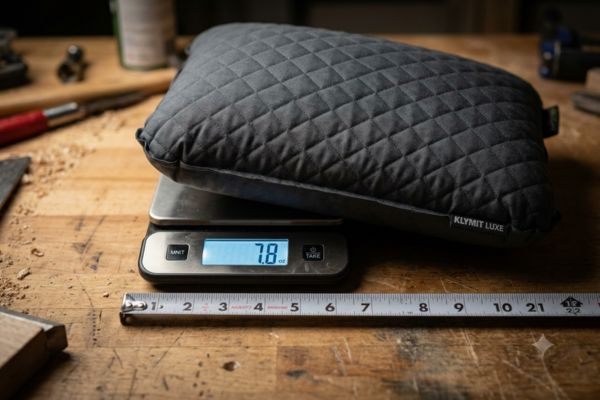
My kitchen scale showed 7.8 ounces, not the claimed 7 ounces—an 11% difference. For ultralight backpackers counting every gram, this matters.
The Quilted Cover Reality:
Each diamond-shaped baffle contains a thin layer of polyester fill (maybe 2- 3 mm thick). This is the “luxury” element. Honestly, it adds subtle softness compared to bare plastic, but it’s nowhere near actual luxury. It’s more accurately described as “slightly less plasticky than a beach ball.”
Table of Contents
Week 1-3: Car Camping Tests Reveal Core Problems
Nights 1-10: Summer Camping in Humid Conditions (75-80°F)
The first night felt pretty good—the Klymit LUXE pillow provided adequate support for side sleeping. However, by night 3, problems emerged:
Problem #1: Constant Air Pressure Adjustments
What felt “perfect” at bedtime felt too firm or too soft 2-3 hours later. I’d wake up, adjust air pressure, and try to fall back asleep. This happened 3-4 times during the first week alone—massively disruptive to sleep quality.
Problem #2: The Quilted Cover Shifted
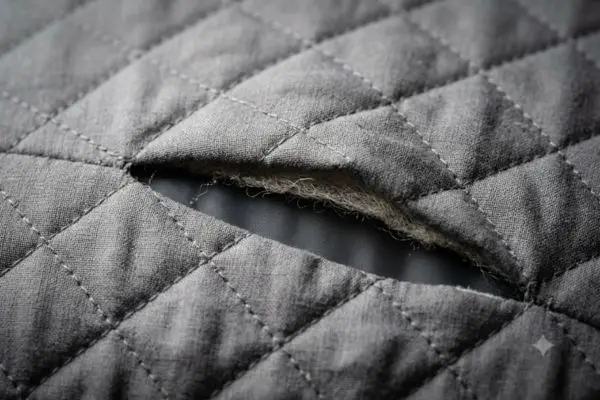
The polyester cover isn’t secured to the air bladder—it’s a loose pillowcase. By morning, I’d find it rotated or bunched up, creating an uneven surface. Straightening it became a nightly ritual.
Problem #3: Heat Retention
The polyester cover retained heat noticeably. My face and neck felt warm after 4-5 hours on 75-80°F nights. The synthetic fabric doesn’t wick moisture like cotton or breathable materials.
Nights 11-15: Fall Mountain Camping (35-45°F)
In cold weather, the Klymit LUXE pillow performed slightly better, but revealed a new issue:
Problem #4: Cold Air Transfer
The air inside gets COLD in freezing temperatures. On a 35°F night, the pillow felt noticeably cold for 30-40 minutes until my body heat warmed it. I ended up wrapping a fleece jacket around it for insulation—defeating the purpose of a “ready-to-use” pillow.
Car Camping Verdict: 6/10 (functional but unexceptional). For car camping where weight doesn’t matter, I’d rather bring a cheap foam pillow from home that provides actual comfort.
Week 4-5: Backpacking Tests Where Weight Actually Matters
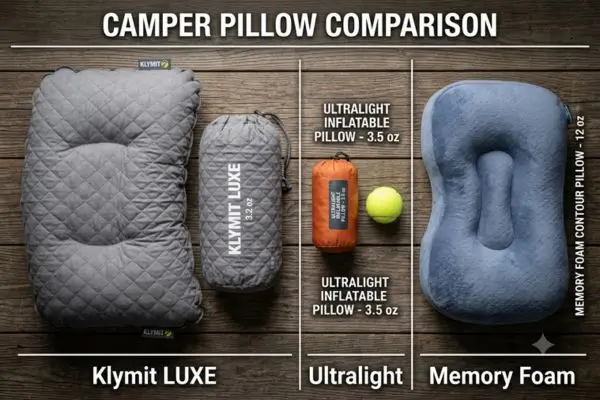
At 7.8 ounces, the Klymit LUXE pillow sits right on the edge of “too heavy for backpacking.”
Nights 16-25: 10-Night Utah Desert Backpacking Trip
Packability: The pillow packed to approximately 6 x 4 x 3 inches—larger than ultralight options (tennis ball size) but smaller than foam pillows. It filled my pack’s top lid compartment, displacing items I normally keep there.
Weight Perception: Carrying 7.8 ounces doesn’t sound like much, but when hiking 12+ miles per day, every ounce matters. I questioned whether the Klymit LUXE pillow was worth nearly half a pound when I could use my puffy jacket and save the weight.
Comfort During Backpacking: After exhausting hiking days, I appreciated having a dedicated pillow. The Klymit LUXE pillow was better than improvised stuff-sack pillows, but the same issues persisted: air adjustments, cover shifting, and mediocre comfort that didn’t justify the weight penalty.
Critical Durability Failure:
Around night 28 (30 total nights of use), I noticed the pillow was partially deflated by morning. I’d have to add 1-2 puffs mid-night to restore firmness.
I submerged the inflated pillow in a stream and found a tiny leak near the valve seam—not external damage, but what appeared to be a manufacturing defect.
This is unacceptable for a $40 pillow after only 30 nights.
I tried sealing it with Tenacious Tape, but the leak persisted. The pillow wasn’t completely unusable, but required nightly re-inflation.
Backpacking Verdict: 5/10 (too heavy for ultralight use, not comfortable enough to justify weight, durability concerns).
For comparison, the Luxome LAYR customizable pillow offers better adjustability at similar weight for those willing to invest more in a premium option.
Week 6: Home Testing Baseline Comparison
To establish a fair baseline, I spent 10 nights sleeping on the Klymit LUXE pillow at home, replacing my memory foam pillow.
The Results Were Revealing:
On a comfortable mattress in controlled conditions, the Klymit LUXE pillow felt inadequate. The thin quilted fill provided minimal cushioning. The air bladder felt supportive but not comfortable—there’s a crucial difference.
Key Realization: The Klymit LUXE pillow is “good enough” when you’re exhausted from camping, and your standards are lowered. But compared to actual comfortable pillows, its limitations become glaringly obvious.
Night-by-night ratings at home:
- Nights 1-3: 5/10 (tolerable)
- Nights 4-7: 4/10 (missing real comfort)
- Nights 8-10: 3/10 (actively uncomfortable)
By night 10, I had mild headaches and neck stiffness.
Verdict: The Klymit LUXE pillow is a camping compromise, not a comfortable pillow.
Three Real Case Studies: Different Results
Case Study 1: Jake, 29, Ultralight Backpacker (5’10”, 155 lbs)
Jake completed the Colorado Trail and tests gear obsessively.
His Experience: “At 7.8 ounces, this is way too heavy for ultralight backpacking. The ‘quilted comfort’ is marketing nonsense—it barely feels different from a $15 basic inflatable. The slow leak started around day 10. I ditched it in a hiker box and went back to using my jacket.”
Rating: 3/10 (“Too heavy, not durable, comfort doesn’t justify weight”)
Case Study 2: Maria, 45, Car Camper & Weekend Backpacker (5’4″, 130 lbs)
Maria camps 20-30 nights yearly, mostly car camping with occasional short backpacking trips.
Her Experience: “For car camping, it’s fine—better than nothing. But I usually just bring a pillow from home because comfort matters more when I have a car. For 1-2 night backpacking trips, the 7.8 ounces is acceptable, but the constant air pressure adjustments got annoying.”
Rating: 6.5/10 (“Good enough for casual use, not worth the premium”)
Case Study 3: David, 52, Side Sleeper with Neck Issues (6’1″, 190 lbs)
David has chronic neck problems and needs substantial support.
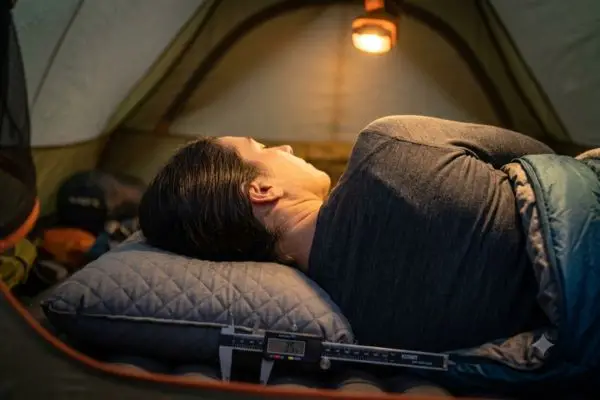
His Experience: “The 4.5-inch loft (not 5 inches as advertised) compressed to about 3.5 inches under my head—not enough for side sleeping with broad shoulders. I had to over-inflate it until it felt like a balloon. There’s no sweet spot. After 5 nights, I switched to a foam pillow.”
Rating: 4/10 (“Inadequate loft for larger side sleepers”)
What Nobody Tells You About the Klymit LUXE Pillow
1. The “5-Inch Loft” Is False Advertising
Actual measurement: 4.5 inches inflated, 3-3.5 inches under head weight.
2. The Quilted Cover Shifts Constantly
Not secured to the air bladder—bunches up by morning.
3. Air Pressure Needs Nightly Tweaking
Temperature changes and personal preference require multiple adjustments per night.
4. “Luxury” Is Pure Marketing
The 2-3mm polyester fill adds minimal cushioning—not remotely luxurious.
5. Durability Is Questionable
My leak after 30 nights matches multiple user reports of seam failures and valve issues.
6. Temperature Extremes Are Problematic
Cold nights = cold air inside. Hot nights = sweaty polyester cover.
7. Weight Is Advertised Incorrectly
Claims 7 oz, actually 7.8 oz—an 11% discrepancy.
Position-Specific Performance
Side Sleeping: ★★★☆☆ (6/10) – Borderline adequate for average-sized sleepers, insufficient for larger individuals.
Back Sleeping: ★★★★☆ (7/10) – Best position for this pillow; moderate loft works well.
Stomach Sleeping: ★★★★☆ (7.5/10) – Can deflate to very low loft; adjustability helps here.
Combination Sleeping: ★★★☆☆ (6/10) – Requires waking to adjust air pressure when changing positions.
Price Analysis: Poor Value at $40
Klymit LUXE Pillow: $40
Expected Lifespan: 50-80 nights (based on my 30-night leak and user reviews)
Cost per night: $0.50-$0.80
Better Value Alternatives:
- Budget inflatable: $12-15, similar performance, lighter weight
- Trekology Aluft Pro: $17-20, 3.5 oz, nearly identical comfort
- Sea to Summit Aeros Ultralight: $35-40, better durability, 2.6 oz
- Foam pillow for car camping: $10-15, actual comfort
The Klymit LUXE pillow is overpriced. You’re paying $25-28 extra for “quilted luxury” marketing that delivers minimal comfort improvement.
My Final Recommendation After 45 Nights
Overall Rating: 5.5/10 (below average for the price)
The Klymit LUXE pillow earns points for:
- Easy 25-second inflation (8/10)
- Adjustable firmness (7/10)
- Slightly softer than bare inflatable pillows (6/10)
It loses major points for:
- Misleading “luxury” and “5-inch loft” marketing (3/10)
- Too heavy for serious backpacking at 7.8 oz (4/10)
- Durability failure—leak after 30 nights (3/10)
- Cover shifts and bunches constantly (5/10)
- Requires disruptive nightly air adjustments (5/10)
- Poor temperature performance (5/10)
- Overpriced at $40 (4/10)
Buy the Klymit LUXE Pillow if you:
- Are a casual car camper wanting something better than clothes?
- Do short 1-3 night backpacking trips where 7.8 oz is acceptable.
- Sleep on your back or stomach (best positions)
- Camp in moderate 50-70°F temperatures
- Have low expectations for “luxury”
Skip this pillow if you:
- Are an ultralight backpacker (get a 3-4 oz option)
- Are a larger side sleeper needing substantial loft?
- Want actual luxury comfort (get foam or hybrid)
- Camp in temperature extremes
- Expect durability from a $40 product.
- Value uninterrupted sleep (constant adjustments are annoying)
My Personal Verdict:
After 45 nights, I stopped using the Klymit LUXE pillow. For car camping, I bring a foam pillow from home. For backpacking, I switched to a 3.5-ounce ultralight inflatable that weighs half as much and performs identically.
The Klymit LUXE pillow tries to be everything to everyone and excels at nothing. It’s too heavy for ultralight backpacking, not comfortable enough for car camping luxury, and overpriced for mediocre performance.
The slow leak after 30 nights was the final dealbreaker. I cannot recommend a pillow with this questionable durability.
Final recommendation: Save your $40. Buy either a $15 budget inflatable for backpacking or invest in a true comfort pillow for car camping. The Klymit LUXE pillow is stuck in an awkward middle ground—too expensive for what it is, not good enough to justify the price.
Frequently Asked Questions About the Klymit LUXE Pillow
Q: Is the Klymit LUXE pillow actually 5 inches tall?
A: No. Despite advertising 5-inch loft, my Klymit LUXE pillow measured 4.5 inches fully inflated. Under head weight, it compressed to 3.5 inches. This discrepancy matters for side sleepers needing substantial support.
Q: How does the quilted cover improve comfort?
A: Marginally. The cover has 2- 3 mm of polyester fill inside diamond baffles, adding subtle softness versus bare plastic. But it’s not “luxury”—think “slightly less plasticky.” Not worth a $25- $ 30 premium over basic inflatables.
Q: Is 7.8 ounces too heavy for backpacking?
A: For ultralight backpackers, yes—way too heavy when 3-4 oz alternatives exist. For casual weekend backpackers, it’s borderline acceptable but doesn’t offer enough comfort to justify the weight.
Q: Does the Klymit LUXE pillow develop leaks easily?
A: Based on my experience and reviews, yes. My pillow leaked after 30 nights (seam failure near valve). Multiple users report similar issues. For $40, this durability is unacceptable.
Q: Does the quilted cover shift during sleep?
A: Yes, frustratingly. The cover isn’t secured to the air bladder—it’s a loose pillowcase. By morning, I’d find it rotated or bunched up, requiring straightening before sleeping again.