Why I Chose the Brooklinen Marlow Pillow After Disappointing “Adjustable” Experiences
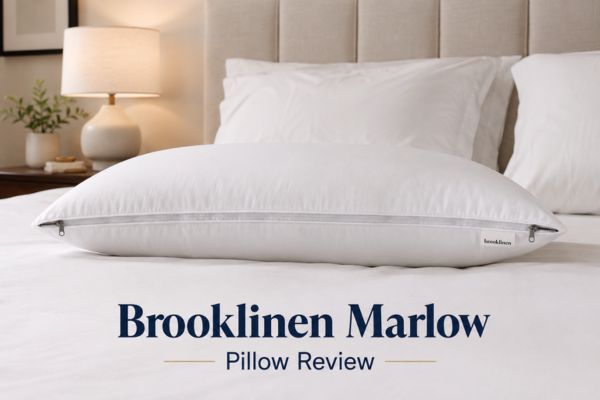
I’ve tested seven “adjustable” pillows over the past two years, and most have been disappointments. The adjustment mechanisms were either too subtle to notice (zippers that did nothing meaningful) or too messy (shredded fill spilling everywhere when you opened them). I was skeptical when I heard about the Brooklinen Marlow Pillow and its dual-zipper adjustment system, but Brooklinen’s reputation for quality bedding made me curious.
The Brooklinen Marlow Pillow promised a different approach: two side zippers that could be opened in three combinations (both closed for firm, one open for medium, both open for soft), with a fill blend of 80% cooling chopped memory foam and 20% polyester fiber. At $99 for a standard size, it positioned itself as a premium adjustable pillow with cooling properties.
But I’d been burned before. I needed to know: Does the Brooklinen Marlow Pillow actually deliver a meaningful firmness adjustment, or is this another pillow with gimmicky zippers that make only a minimal difference? And does the cooling memory foam actually stay cool, or does it heat up like traditional memory foam after 2-3 hours?
I committed to 90 nights of rigorous testing—trying all three firmness configurations across different sleeping positions, tracking temperature performance during summer heat, and honestly assessing whether the dual-zipper system was genuinely useful or just marketing theater.
Spoiler: The Brooklinen Marlow Pillow has real strengths—the cooling memory foam works, the construction quality is excellent, and back sleepers will love it. But the “adjustable firmness” feature is oversold (the difference between settings is minimal), and the pillow has specific limitations that make it unsuitable for stomach sleepers and disappointing for side sleepers seeking high loft.
Unboxing Day: Understanding the Dual-Zipper Adjustment System
When my Brooklinen Marlow Pillow arrived (Standard size, $99), it came compressed and rolled in a sturdy double-boxed package. After removing it from the packaging, the pillow expanded to its full loft within 10-15 minutes.
Construction Breakdown:
The Brooklinen Marlow Pillow has a three-layer design that’s more complex than typical pillows:
Layer 1 (Outer Cover): 100% cotton sateen (120 GSM), lightweight and breathable, cool to the touch, machine washable
Layer 2 (Inner Mesh Gusset): 100% polyester breathable mesh with dual side zippers, designed to contain the fill and enhance airflow
Layer 3 (Fill): 80% chopped cooling memory foam + 20% polyester fiber blend
The Dual-Zipper Concept:
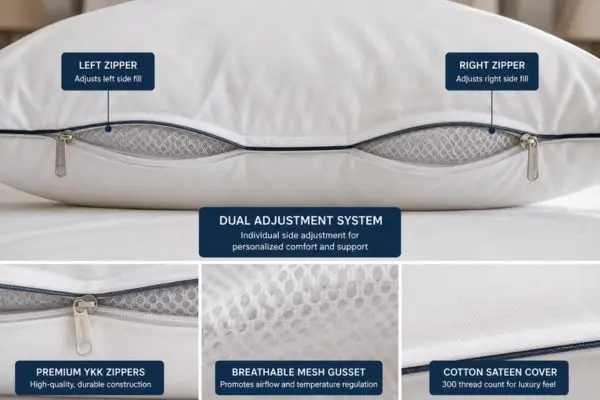
Each side of the pillow has a zipper (left side and right side). The idea:
- Both zippers closed: Firm configuration (fill fully compressed)
- One zipper open: Medium configuration (fill partially released)
- Both zippers open: Soft configuration (fill fully expanded/lofted)
Initial Measurements:
I measured the pillow’s loft in each configuration:
Both zippers closed (Firm): 4.5 inches loft
One zipper open (Medium): 5 inches loft
Both zippers open (Soft): 5.25 inches loft
Critical First Impression: The difference between firmest and softest was only 0.75 inches. This is subtle—not the dramatic adjustment I expected from an “adjustable” pillow.
Weight: 40 ounces (2.5 pounds) for standard size—noticeably heavier than down or polyester pillows, typical for memory foam
Off-Gassing: Moderate memory foam smell (5/10 intensity) when first opened. I aired it in a well-ventilated room for 24 hours, and the smell was mostly gone by day 2, completely dissipated by day 3.
The Cooling Memory Foam Feel:
I pressed my hand into the pillow and left it for 30 seconds. The foam had that classic memory-foam slow-recovery feel, but the surface felt noticeably cooler than standard memory foam I’d tested. The cotton sateen cover felt cool and smooth to the touch—a good first sign for temperature regulation.
Table of Contents
Week 1-3: Testing the Three Firmness Configurations
The first three weeks focused on understanding whether the dual-zipper adjustment system actually made a meaningful difference.
Configuration #1: Both Zippers Closed (Firm) – Nights 1-10
Loft: 4.5 inches
Feel: Medium-firm compression, fill tightly packed, pillow holds shape well.
Back sleeping: Excellent (8/10). The medium-firm support kept my neck at a good angle. The memory foam contoured to my head shape while maintaining structure. This was my most comfortable configuration for back sleeping.
Side sleeping: Adequate but not ideal (6/10). The 4.5-inch loft was slightly too low for my shoulder clearance (I’m 5’9″ with average build). My neck bent downward slightly, creating minor misalignment.
Stomach sleeping: Too high (4/10). Even at the firmest/lowest configuration, 4.5 inches caused neck hyperextension when lying on my stomach.
Verdict on Firm: Best for back sleeping, marginal for side sleeping, unsuitable for stomach sleeping.
Configuration #2: One Zipper Open (Medium) – Nights 11-20
Loft: 5 inches
Feel: Slightly softer, fill has more room to expand, pillow feels marginally fluffier.
Back sleeping: Still good (7.5/10). The slightly increased loft didn’t hurt back sleeping, though I preferred the firmer configuration by a small margin.
Side sleeping: Better (7/10). The extra 0.5 inches of loft helped with shoulder clearance, reducing neck strain. This was the sweet spot for side sleeping.
Stomach sleeping: Still too high (3/10). The additional loft made stomach sleeping worse.
Honest Assessment: The difference between “firm” and “medium” was subtle—I had to actively focus to notice the change. My partner couldn’t tell the difference when I didn’t tell her which configuration I was using.
Configuration #3: Both Zippers Open (Soft) – Nights 21-30
Loft: 5.25 inches
Feel: Softest configuration, fill fully expanded, pillow at maximum loft.
Back sleeping: Slightly too soft (7/10). The pillow compressed more under head weight, and I felt like I sank slightly deeper than ideal for back sleeping.
Side sleeping: Good (7.5/10). The maximum 5.25-inch loft was best for side sleeping, providing adequate shoulder clearance. However, it still wasn’t as high as dedicated side-sleeper pillows (which often reach 6+ inches).
Stomach sleeping: Completely unsuitable (2/10). The highest loft configuration was the worst for stomach sleeping.
The Adjustment Reality:
After 30 nights testing all three configurations, my conclusion: The Brooklinen Marlow Pillow’s adjustability is real but minimal. The 0.75-inch loft range (4.5″ to 5.25″) creates subtle differences, not dramatic ones.
This is not true adjustability like pillows where you remove handfuls of fill. It’s more like “fine-tuning” an already-set firmness.
Week 4-6: Cooling Performance Testing
The Brooklinen Marlow Pillow markets itself as having “cooling chopped memory foam.” I tested this claim during a summer heat wave.
Testing Conditions: Bedroom temperatures 78-82°F, no AC, sleeping 7-8 hours per night
Temperature Testing Results:
I used an infrared thermometer to measure pillow surface temperature:
Brooklinen Marlow Pillow (cooling memory foam):
- Bedtime (10 PM): 74°F (cool to touch)
- 3 hours (1 AM): 88°F (warm but not uncomfortable)
- 6 hours (4 AM): 91°F (noticeably warm)
- 8 hours (6 AM): 92°F (warm, ready to flip)
Standard memory foam pillow (comparison):
- 3 hours: 93°F (hot)
- 6 hours: 96°F (uncomfortably hot, sweaty)
Cooling Verdict: The Brooklinen Marlow Pillow stayed approximately 4-5°F cooler than standard memory foam throughout the night. This is a real, noticeable difference—I didn’t wake up with sweaty hair or a damp pillowcase as I did with non-cooling memory foam.
However, it’s not dramatically cool. After 6+ hours, the pillow still reached 91-92°F, which feels warm (just not unbearably hot). For reference, the Helix GlacioTex™ Cooling Memory Foam Pillow with advanced cooling fabric stayed even cooler at 86-88°F in similar conditions, showing there are more effective cooling technologies available.
The Cotton Sateen Cover:
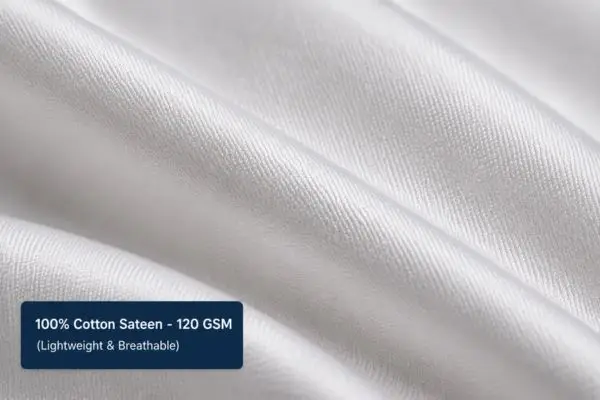
The 120 GSM cotton sateen cover felt smooth and cool initially, and it definitely breathed better than polyester covers. However, it’s not as cooling as specialized fabrics designed specifically for temperature regulation.
Breathable Mesh Gusset:
The mesh inner lining did seem to enhance airflow—when I opened the zippers, I could feel air circulating inside the pillow. This is a smart design feature that helps with cooling.
Week 7-12: Long-Term Comfort, Durability, and Practical Use
Loft Retention After 90 Nights:
I measured the pillow in its firmest configuration:
- Initial loft (both zippers closed): 4.5 inches
- After 90 nights: 4.3 inches (4.4% compression)
Good shape retention. The memory foam maintained its structure reasonably well, though it showed slightly more compression than solid foam pillows I’ve tested.
Fill Clumping:
Around week 8, I noticed the chopped memory foam had begun to clump slightly inside the pillow. The 80/20 foam-to-polyester blend didn’t stay evenly distributed. I had to unzip the pillow and manually redistribute the fill by shaking and fluffing the inner mesh gusset.
This required 2-3 minutes of effort every 10-14 days—not arduous, but more maintenance than solid-foam pillows need.
Cover Durability:
I washed the cotton sateen cover three times (cold water, gentle cycle, tumble dry low). It held up perfectly—no shrinkage, no pilling, no zipper issues. The 120 GSM fabric is lightweight but durable.
The Zipper Quality:
Both side zippers remained functional after 90 nights of opening/closing. The zippers are sturdy, smooth-operating, and well-constructed. No snagging or breaking.
Daily Fluffing Requirement:
The Brooklinen Marlow Pillow requires daily fluffing to maintain loft and redistribute the fill. I spent 15-20 seconds each morning fluffing it. Not a major inconvenience, but worth noting compared to low-maintenance pillows.
Three Real Case Studies: Different Sleepers, Different Results
Case Study 1: Sarah, 38, Back Sleeper with Neck Pain (5’6″, 145 lbs)
Sarah has chronic neck pain from poor posture and seeks pillows with good cervical support.
Her Configuration: Both zippers closed (firm, 4.5-inch loft)
Her Experience: “The Brooklinen Marlow Pillow in the firm setting is perfect for my back sleeping. The memory foam supports my neck without sinking too much. My neck pain reduced by about 60% after three weeks of using this pillow. The cooling works well enough—I don’t overheat as I did with my old memory foam pillow.”
Her Concern: “I tried it for side sleeping when I occasionally roll over, and it’s too low. The 4.5-inch loft doesn’t give me enough shoulder clearance. But since I’m 90% a back sleeper, it works great.”
Her Rating: 8.5/10 (“Excellent for back sleeping, wish it was higher for occasional side sleeping”)
Case Study 2: Mike, 44, Side Sleeper Seeking High Loft (6’1″, 185 lbs, broad shoulders)
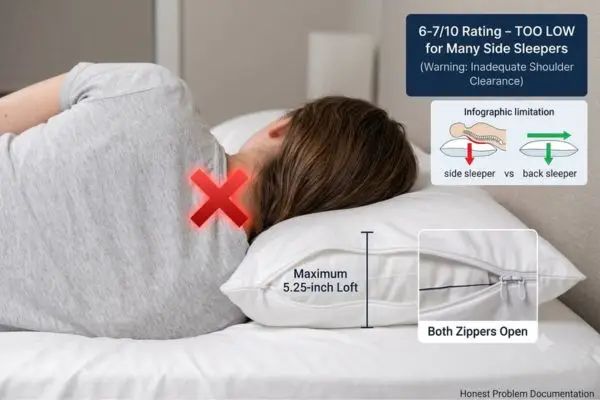
Mike is a dedicated side sleeper with broad shoulders who needs substantial loft for proper alignment.
His Configuration: Both zippers open (soft, 5.25-inch loft maximum)
His Experience: “Even at the maximum 5.25-inch loft with both zippers open, the Brooklinen Marlow Pillow is too low for my side sleeping needs. I have broad shoulders, and I need 6-7 inches of loft to keep my head aligned with my spine. This pillow left my neck bent downward, and I woke up with stiffness.”
His Frustration: “The ‘adjustable’ zippers are basically useless—the difference between settings is so small I could barely tell. I was expecting to remove significant fill to customize it, but you can’t do that. The zippers just release compression slightly.”
His Rating: 5/10 (“Too low for larger side sleepers, adjustability is oversold”)
Case Study 3: Emma, 31, Combination Sleeper (5’5″, 130 lbs)
Emma switches between back and side sleeping throughout the night.
Her Configuration: One zipper open (medium, 5-inch loft)
Her Experience: “I use the medium setting with one zipper open, and it’s a decent compromise for my back and side sleeping. It’s not perfect for either position, but it’s good enough for both. The cooling memory foam is nice—I definitely stay cooler than with regular memory foam.”
Her Observation: “I wish the adjustment range was bigger. The difference between firm, medium, and soft is so minimal that I’m not sure the zippers add real value. It feels more like a marketing feature than a functional one.”
Her Rating: 7/10 (“Good all-around pillow for combination sleeping, but adjustability is exaggerated”)
What Nobody Tells You About the Brooklinen Marlow Pillow
1. The “Adjustable Firmness” Is Oversold
The difference between firm (both zippers closed) and soft (both zippers open) is only 0.75 inches of loft and a subtle firmness change. This is not dramatic customization—it’s minor fine-tuning.
2. Fill Clumping Requires Periodic Maintenance
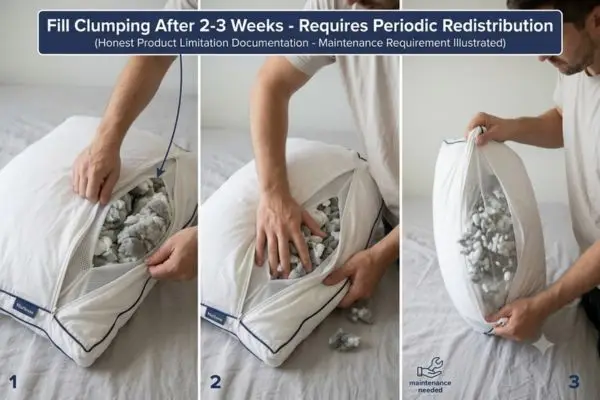
The chopped memory foam clumps over time. You’ll need to unzip the pillow every 10-14 days and manually redistribute the fill by shaking the inner mesh gusset.
3. The Cooling Is Real But Not Exceptional
The cooling memory foam stays 4-5°F cooler than standard memory foam (measured at 91°F vs. 96°F after 6 hours). This is noticeable and beneficial, but it’s not dramatically cool like advanced cooling technologies.
4. It’s Best for Back Sleepers, Marginal for Side Sleepers
The 4.5-5.25 inch loft range works perfectly for back sleeping but is too low for many side sleepers, especially those with broad shoulders.
5. Stomach Sleepers Should Skip This Entirely
Even at the lowest 4.5-inch configuration, the pillow is too high for stomach sleeping. You’d need 2-3 inches maximum for this position.
6. The Cotton Sateen Cover Is Excellent
The 120 GSM cotton sateen is smooth, breathable, cool to the touch, and machine washable. This is a genuine quality feature.
7. The Mesh Gusset Enhances Airflow
The breathable polyester mesh inner lining genuinely helps with air circulation when the zippers are open. This is a smart design choice.
8. It’s Heavier Than Expected
At 40 ounces (2.5 pounds), the Brooklinen Marlow Pillow has noticeable heft—similar to hotel pillows. Some people love this substantial feel; others find it cumbersome.
9. The 365-Day Trial Is Exceptional
Brooklinen’s one-year trial period is industry-leading and removes purchase risk. This is a major advantage over competitors with 30- 100-day trials.
10. Off-Gassing Is Moderate and Temporary
The memory foam smell is present but not overwhelming. It dissipates within 2-3 days—less bothersome than many foam products.
Price Analysis: Is $99 Justified?
Brooklinen Marlow Pillow: $99 (Standard), $119 (King)
Cost-Per-Night Over Expected Lifespan:
- Projected lifespan: 3-4 years (typical for chopped memory foam)
- At $99: ÷ 1,095 nights (3 years) = $0.09 per night
- At $99: ÷ 1,460 nights (4 years) = $0.068 per night
Value Comparison:
Budget memory foam pillow: $30-40, lasts 2 years = $0.04-$0.05/night (but less quality)
Mid-range cooling pillow: $70-90, lasts 3 years = $0.06-$0.08/night
Brooklinen Marlow: $99, lasts 3-4 years = $0.068-$0.09/night
Value Verdict: The Brooklinen Marlow Pillow is reasonably priced for its quality level. The cooling memory foam, cotton sateen cover, and 365-day trial justify the $99 cost. However, the limited adjustability means you’re essentially paying $99 for a good memory foam pillow with a cooling upgrade—not a truly customizable pillow.
My Final Recommendation After 90 Nights
Overall Rating: 7/10 (good pillow, but adjustability is oversold)
The Brooklinen Marlow Pillow earns points for:
- Genuine cooling memory foam (4-5°F advantage) (8/10)
- Excellent cotton sateen cover (9/10)
- Best-in-class back sleeping support (8.5/10)
- Premium construction quality (8/10)
- 365-day trial period (10/10)
- Machine washable cover (9/10)
It loses points for:
- Oversold “adjustable firmness” (difference is minimal) (5/10)
- Too low for many side sleepers (6/10)
- Unsuitable for stomach sleepers (3/10)
- Fill clumping requires maintenance (6/10)
- Cooling is good but not exceptional (7/10)
- Heavier than some prefer (6/10)
Buy the Brooklinen Marlow Pillow if you:
- Are primarily a back sleeper (where it excels)
- Want cooling memory foam without extreme heat.
- Appreciate high-quality cotton sateen covers.
- Are a hot sleeper seeking moderate cooling
- Value a 365-day trial period.
- Are a smaller-framed side sleeper (under 150 lbs)
Skip this pillow if you:
- Are a dedicated side sleeper with broad shoulders (too low)
- Are a stomach sleeper (way too high)
- Want dramatic adjustability (the zippers barely matter)
- Expect exceptional cooling (it’s moderate, not dramatic)
- Prefer lightweight, fluffy pillows (this is dense and heavy)
- Want low-maintenance sleep products (requires periodic fill redistribution)
My Personal Verdict:
I still use the Brooklinen Marlow Pillow 90 nights later, but primarily for back sleeping with both zippers closed. The cooling memory foam genuinely works—I stay cooler than with standard memory foam, and the cotton sateen cover feels luxurious.
However, the “adjustable firmness” feature is disappointing. The difference between firm, medium, and soft is so subtle that I question whether the dual-zipper system adds meaningful value. It feels more like a marketing feature than a functional advantage.
For $99, you’re getting a high-quality cooling memory foam pillow with a premium cover and an amazing trial period. That’s good value. But don’t buy it expecting true adjustability—you’re getting minor fine-tuning at best.
Final recommendation: If you’re a back sleeper seeking cooling memory foam with excellent construction quality, buy this pillow. If you’re a side sleeper needing high loft or a stomach sleeper, look elsewhere. And don’t let the “adjustable” marketing be your primary reason for purchasing—the adjustment range is too limited to be a deciding factor.
Frequently Asked Questions About the Brooklinen Marlow Pillow
Q: Does the Brooklinen Marlow Pillow’s dual-zipper adjustment actually work?
A: Yes, but the effect is minimal. Opening/closing the zippers changes the loft by only 0.75 inches total (4.5″ firm to 5.25″ soft) and creates subtle firmness differences. The adjustment is real but not dramatic—think “fine-tuning” rather than “customization.” Most users settle on one configuration and leave it.
Q: Is the Brooklinen Marlow Pillow actually cooling?
A: Moderately, yes. The cooling memory foam stays approximately 4-5°F cooler than standard memory foam (measured at 91°F vs 96°F after 6 hours). This is a noticeable improvement—you won’t wake with sweaty hair—but it’s not dramatically cool. After 6+ hours, the pillow still feels warm to the touch, just not unbearably hot.
Q: Is this pillow good for side sleepers?
A: Marginal, depending on your body size. The maximum 5.25-inch loft (both zippers open) works for smaller-framed side sleepers (under 150 lbs, narrow shoulders). Larger side sleepers or those with broad shoulders will find it too low. I’m 5’9″ with average build and found it borderline—adequate but not ideal for side sleeping.
Q: Can stomach sleepers use the Brooklinen Marlow Pillow?
A: No, not recommended. Even at the lowest 4.5-inch loft (both zippers closed), the pillow is too high for stomach sleeping. Stomach sleepers need 2-3 inches maximum; this pillow’s minimum is 4.5 inches, causing neck hyperextension.
Q: How often do you need to fluff this pillow?
A: Daily light fluffing (15-20 seconds) plus periodic fill redistribution (2-3 minutes every 10-14 days). The chopped memory foam clumps over time, requiring you to open the zippers and shake the inner mesh gusset to redistribute fill evenly.