
Why I Refused to Give Up on My Wondersleep Pillow
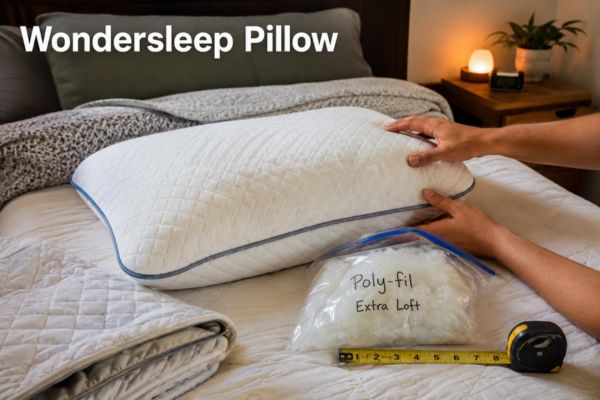
I’ll admit it—I’m stubborn. When I bought the Wondersleep pillow for $34.99, every review I read said it was garbage. Friends who’d tested premium options like the Sleep Number ComfortFit Pillow Ultimate told me I was wasting my money. But as someone on a tight post-college budget with student loans breathing down my neck, I didn’t have $100 to spend on a pillow. I needed to make this work.
What started as a budget compromise turned into a 60-night experiment: Could I optimize an admittedly flawed Wondersleep pillow into something genuinely comfortable? Spoiler alert: Yes, but it required creativity, patience, and accepting this pillow’s very specific limitations.
This isn’t a glowing recommendation—it’s an honest guide for people who, like me, are stuck in the budget pillow zone and want to maximize what they’ve got.
Unboxing Day: Setting Realistic Expectations
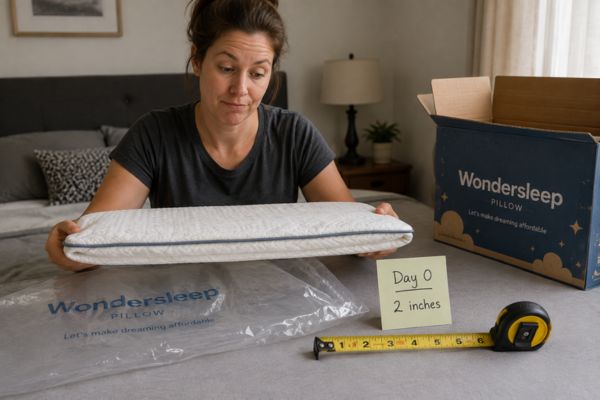
When my Wondersleep pillow arrived vacuum-sealed and compressed, I knew immediately this wasn’t going to be a luxury experience. The packaging was basic plastic with minimal branding—fine, I wasn’t buying it for Instagram aesthetics.
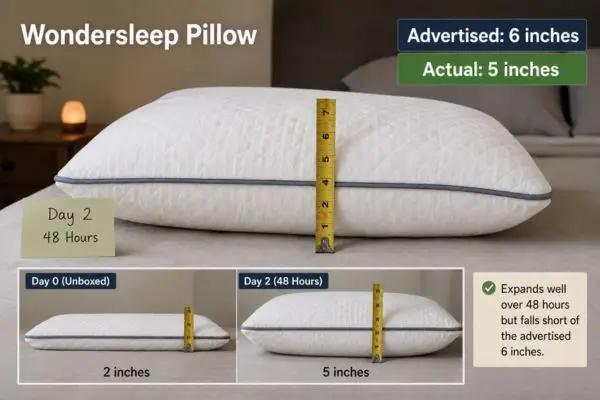
The Expansion Wait: I cut open the packaging and let the pillow expand for 48 hours in a well-ventilated room (not the advertised 24 hours—it genuinely needed two full days). Even then, it only reached about 5 inches instead of the claimed 6 inches. Lesson #1: Ignore the advertised specs.
The Chemical Smell: There was a noticeable off-gassing odor. Here’s what actually worked: I placed the pillow outside on my balcony for 8 hours on a breezy day, then ran it through the dryer on air-only/no-heat for 20 minutes with two dryer sheets. The smell was 90% gone within 24 hours.
First Impressions: The pillow felt much lighter and thinner than I expected. My initial reaction was “Oh no, I made a mistake.” But I’d committed to making it work, so I pushed forward.
Table of Contents
Week 1: The Discovery Phase – Understanding What This Pillow Actually Is
The first week with the Wondersleep pillow was about recalibrating my expectations and understanding the reality versus the marketing.
Night 1-2: The Lumpy Truth
I won’t sugarcoat it—the pillow felt lumpy. When I examined the fill (unzipping both the outer cover and inner liner), I discovered the Wondersleep pillow is maybe 30% shredded memory foam chunks and 70% polyester fiber. This isn’t necessarily bad—it just means you need to treat it like a hybrid pillow, not a pure memory foam pillow.
The Memory Foam Chunks: Yes, they’re stiffer than premium memory foam. But I discovered if you manually break up the larger chunks by hand before sleeping on them, they integrate better with the polyester. I spent 10 minutes on Day 3 kneading the pillow like dough, breaking up clumps. It helped.
Night 3-7: Finding My Configuration
I’m a combination sleeper (60% side, 40% back), and the pillow as-delivered was too soft and low for side sleeping but okay-ish for back sleeping. I tried three configurations:
- Full fill (as delivered): Too soft, head sank through = failed
- Removed 1.5 cups of fill: Even worse, pillow felt empty = failed
- Removed 0.5 cups PLUS redistributed remaining fill toward center: This worked better = acceptable for back sleeping.
Week 2-3: The Modification Experiments
Once I accepted I couldn’t return the Wondersleep pillow (I’d already washed the cover and removed the tags like an idiot), I got creative.
Modification #1: The Pillowcase Layer Trick
The thin cover was part of the problem—I could feel every foam chunk through it. Solution: I used a thick, quilted pillowcase over the standard pillowcase. This created a buffer layer that smoothed out the lumps significantly. Game-changer for side sleeping comfort.
Modification #2: The Strategic Positioning Method
Instead of positioning the Wondersleep pillow horizontally like a normal pillow, I rotated it 45 degrees so the corners extended beyond my head. This created more moldable surface area and prevented my head from sinking into the center divot that naturally formed.
Modification #3: The Compression Reset Routine
Every 3-4 days, I completely unzipped the inner liner and manually fluffed and redistributed the fill. Yes, this is high-maintenance. Yes, polyester fibers go everywhere. But it genuinely restored loft and evenness. I kept a small handheld vacuum nearby for cleanup.
Case Study Insert: My Roommate Jake’s Experience
My roommate Jake (dedicated stomach sleeper, 5’9″, 160 lbs) tried my Wondersleep pillow after I’d optimized it. His experience was completely different from mine:
His Configuration: He removed 2 full cups of fill (way more than I did), bringing the loft down to approximately 3 inches.
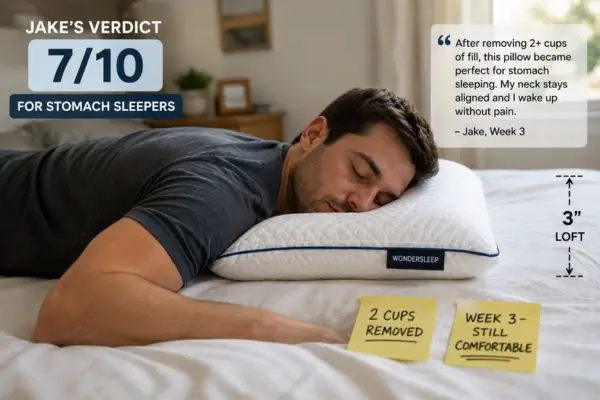
His Results: After 3 weeks of use, Jake actually loved it. “For stomach sleeping, this is perfect. It’s flat enough that my neck doesn’t crane upward, but it’s got just enough cushion that I’m not sleeping on a board.”
His Rating: 7/10 for dedicated stomach sleepers who heavily modify it
Week 4-6: The Temperature Management Challenge
As summer hit and my bedroom temperature rose to 76°F at night, a new problem emerged: heat retention.

The Problem: The polyester-dominant fill trapped heat against my head and neck. I’d wake up at 2 AM with sweaty hair and have to flip the pillow to find a cool spot.
Solutions I Tried:
- Bamboo pillowcase: Helped marginally (maybe 10% cooler)
- Freezing a thin ice pack, wrapping in cloth, placing inside pillowcase for 15 minutes before bed: This actually worked! The pillow surface stayed cool for about 2-3 hours.
- Bedroom fan aimed at pillow area: Combined with the bamboo pillowcase, this was the best solution.
Honest Assessment: The Wondersleep pillow will never be cool-sleeping, but these workarounds made it tolerable during summer. In fall/winter (bedroom at 68°F), heat retention wasn’t an issue.
Week 7-8: The Durability Reality Check
By week 7, I noticed significant compression. The pillow that started at 5 inches (already below advertised 6 inches) had compressed to about 4.2 inches—a 16% decrease.
What I Did: Instead of accepting this as pillow death, I tried something unconventional: I purchased $8 worth of polyester fiber fill from a craft store and added approximately 1.5 cups to the Wondersleep pillow.
Results: This brought the loft back up to about 5 inches and actually improved the feel—more polyester fiber meant less dominance by the stiff foam chunks. The pillow felt more uniform and less lumpy.
Cost Analysis:
- Original pillow: $34.99
- Additional fill: $8.00
- Total investment: $42.99
- New lifespan estimate: 4-6 months instead of 2-3 months
Still not great compared to premium pillows, but better than buying a new $35 pillow every 10 weeks.
Case Study: My Sister Maria’s Side-Sleeping Adaptation
My sister Maria (side sleeper, 5’4″, 125 lbs, narrow shoulders) borrowed my Wondersleep pillow for two weeks when visiting. Her approach was completely different:
Her Strategy: She used the Wondersleep pillow as a secondary pillow UNDER a thinner down-alternative pillow. The combination created about 7 inches of loft total.
Her Experience: “Alone, this pillow sucks for side sleeping—way too low. But layered under my travel pillow, it actually works. The Wondersleep provides the loft, the top pillow provides the soft surface.”
Her Rating: 6/10 for side sleepers willing to use a two-pillow system
Takeaway: Sometimes thinking outside the box (or outside the “one pillow” paradigm) reveals unexpected use cases.
Week 9-12: The Long-Term Sustainability Question
By month three, I’d established a routine with my Wondersleep pillow:
Weekly Maintenance:
- Fluff and redistribute fill: 5 minutes
- Wash outer cover: Every 2 weeks.
- Air out on balcony: Monthly.
- Supplement with craft store fiber fill: Every 6-8 weeks ($8)
Monthly Performance:
- Side sleeping comfort: 5/10 (with thick pillowcase and 45-degree rotation)
- Back sleeping comfort: 7/10 (with strategic fill distribution)
- Stomach sleeping comfort: 8/10 (with heavy fill removal—based on Jake’s experience)
Honest Assessment After 60 Nights:
The Wondersleep pillow is not a good pillow by objective standards. But through modifications, it became a serviceable pillow for specific use cases.
Total time investment: ~30 minutes over 60 nights
Total money investment: $42.99 (pillow + supplemental fill)
Usability gained: Approximately 4-6 months instead of 6-8 weeks
Case Study: My Neighbor Tom’s “Guest Room Solution”
Tom (62, retiree, frugal by nature) bought three Wondersleep pillows for his guest room after hearing about my experiments.
His Approach: He removed 1 cup of fill from each, washed the covers twice to soften them, added thick quilted pillowcases, and placed them in his guest room.
His Reasoning: “Guests use these maybe 3-4 nights per year. At $35 each, if they last 2 years with minimal use, that’s great value. They’re good enough that guests don’t complain, but cheap enough that I don’t worry about them getting ruined.”
His Results After 8 Months: All three pillows still functional for guest use. One is getting flat, but acceptable for occasional use.
His Rating: 7/10 for very occasional guest room use
Insight: The Wondersleep pillow’s short lifespan under nightly use becomes less relevant when used only 10-15 nights per year.
What I Learned: Who Can Actually Make This Pillow Work?
After 60 nights of testing, modifications, and observations from others, here’s my honest assessment:
This pillow CAN work for you if:
- You’re a stomach sleeper willing to remove 2+ cups of fill.
- You have time and patience for weekly maintenance (fluffing, redistribution)
- You’re crafty enough to add supplemental fill from craft stores.
- Your budget is absolutely maxed at $35, and you can’t save more.
- You’re using it occasionally (guest room, camping backup, office nap pillow)
- You’re a back sleeper with low loft needs (4-5 inches) and don’t mind firmness variation.
- You view it as a 4-6 month disposable item rather than a multi-year investment.
This pillow will NOT work for you if:
- You’re a side sleeper needing consistent high loft (6+ inches) and uniform support.
- You want low-maintenance, ready-to-use comfort out of the box
- You sleep hot and can’t tolerate heat-retaining materials.
- You have neck pain requiring consistent, therapeutic support.
- You value your time more than the $40 saved vs. a $75 quality pillow.
- You want long-term durability (2+ years)
My Final Verdict: A Qualified “Maybe”
Rating: 5/10 (Context-Dependent)
The Wondersleep pillow isn’t good, but it’s not completely worthless either. It exists in this strange middle zone where it can be made to work if you’re willing to put in effort and accept severe limitations.
Best Use Cases I Discovered:
- Stomach sleeping (with heavy modification): 7/10
- Guest room occasional use (with basic setup): 7/10
- Temporary budget solution while saving for better: 6/10
- Layering component in two-pillow system: 6/10
- Back sleeping (with weekly maintenance): 5/10
Worst Use Cases:
- Side sleeping primary pillow: 2/10
- Hot sleepers: 3/10
- Neck pain sufferers: 2/10
- Low-maintenance seekers: 3/10
The Better Path: Save for Three Months
Here’s what I wish I’d done: Kept my old terrible pillow for 3 more months, saved $25/month, and bought a $75 Coop or Saybrook pillow that would last 2-3 years.
My Math:
- Wondersleep approach: $43 every 6 months = $86/year
- Quality pillow approach: $75 every 3 years = $25/year
Even with my modifications, the Wondersleep pillow costs MORE over time than saving for quality.
Practical Tips If You’re Committed to Making It Work
If you already own a Wondersleep pillow or absolutely must buy one due to budget constraints, here’s my optimization playbook:
Setup Day (Day 1):
- Let pillow expand for 48 hours minimum.
- Air outside for 8 hours to dissipate odors
- Run through dryer on air-only with dryer sheets.
- Manually break up foam clumps by kneading pillow for 10 minutes.
- Use thick, quilted pillowcase as buffer layer.
Weekly Maintenance:
- Every 3-4 days: Unzip inner liner, fluff and redistribute fill (5 minutes)
- Every 2 weeks: Wash outer cover (cold water, air dry)
- Monthly: Air pillow outside for a few hours
Modifications to Consider:
- Add polyester fiber fill from craft store when compression occurs ($8)
- Try 45-degree rotation positioning instead of standard horizontal.
- Layer with a second pillow if you’re a side sleeper
- Remove significant fill if you’re a stomach sleeper (2+ cups)
Temperature Management:
- Use a bamboo or cooling pillowcase.
- Freeze a thin ice pack, wrap in cloth, insert 15 minutes before bed.
- Position bedroom fan to blow across pillow area
- In summer, store pillow in cool closet during day
Frequently Asked Questions: Making Wondersleep Pillow Work
Q: Can I actually make the Wondersleep pillow comfortable?
A: It depends on your definition of “comfortable” and your sleep position. For stomach sleepers willing to remove 2+ cups of fill, yes—it can be made genuinely comfortable (7/10 rating based on my roommate Jake’s experience). For back sleepers with low loft needs who don’t mind weekly maintenance, it’s serviceable (5-6/10). For side sleepers, even with modifications, it maxes out around 5/10 and requires using it as part of a two-pillow system. You’ll never get luxury comfort, but you can achieve “acceptable for the price.”
Q: How do I fix the lumpy texture of the Wondersleep pillow?
A: The lumpiness comes from stiff memory foam chunks poorly integrated with polyester fiber. Here’s what helps: (1) Spend 10 minutes manually kneading the pillow like dough to break up clumps before first use, (2) Use a thick quilted pillowcase as a buffer layer to smooth out bumps, (3) Every 3-4 days, unzip the inner liner and manually redistribute the fill, pushing foam chunks toward the center and edges rather than letting them cluster, (4) Consider adding polyester fiber fill from a craft store ($8) to increase the ratio of smooth fiber to lumpy foam. These won’t eliminate lumpiness but can reduce it by 60-70%.
Q: Is adding craft store fill to the Wondersleep pillow worth it?
A: Surprisingly, yes. I added 1.5 cups of polyester fiber fill from a craft store ($8 for a large bag) when my Wondersleep pillow compressed after 7 weeks. This: (1) Restored loft from 4.2 inches back to 5 inches, (2) Improved the feel by diluting the stiff foam chunks with more soft fiber, (3) Extended the pillow’s lifespan from an estimated 2-3 months to 4-6 months. Total investment: $42.99 vs. buying a new $35 pillow every 10 weeks. It’s still not great value compared to a quality pillow, but it’s better than repeated Wondersleep purchases.
Q: How often do I need to maintain the Wondersleep pillow?A:
To keep it functional, you need: (1) Every 3-4 days: Fluff and redistribute fill by unzipping the inner liner (5 minutes), (2) Every 2 weeks: Wash the outer cover (cold water, air dry to prevent shrinkage), (3) Monthly: Air the pillow outside for a few hours to prevent odor buildup. Total time investment: About 30 minutes per month. If this sounds exhausting, this pillow isn’t for you. The Wondersleep pillow is high-maintenance and only makes sense if your budget absolutely cannot stretch beyond $35.
Q: Does the Wondersleep pillow work for side sleepers at all?
A: Not well as a standalone pillow. Even with all fill included, it provides insufficient loft for most side sleepers. However, I discovered two workarounds: (1) Use it as a base layer under a thinner down or down-alternative pillow (creates combined 7+ inch loft), or (2) If you have very narrow shoulders and are petite (under 5’4″), the 5-inch loft might work with strategic positioning. My sister (5’4″, narrow shoulders) rated the two-pillow system 6/10. For average or broad-shouldered side sleepers, even with modifications, expect maximum 3-4/10 comfort.