
For years, I thought all pillows were basically the same.
Some were softer. Some were firmer. Some were more expensive.
But then I kept waking up with stiffness at the base of my skull, and someone asked me a simple question:
“Have you tried a cervical pillow?”
That’s when I started researching: what is a cervical pillow, and is it actually different — or just another marketing term?
After testing one myself and understanding how it works, I realized there’s much more to it than I expected.
If you’re wondering what a cervical pillow is, this guide will explain what it does, who needs one, and whether it’s worth switching.
Table of Contents
What Is a Cervical Pillow?

A cervical pillow is a specially shaped pillow designed to support the natural curve of your neck (the cervical spine) while you sleep.
Unlike regular pillows that are flat across the surface, a cervical pillow typically has:
- A raised edge to support the neck
- A lower center where the head rests
- Contoured or wave-like structure
- Often made of memory foam or latex.
So when someone asks, what is a cervical pillow, the simplest answer is:
It’s a pillow built specifically to maintain neutral neck alignment.
Why Regular Pillows Sometimes Fail
Before I understood what a cervical pillow is, I assumed neck pain was normal.
But here’s the issue:
Most traditional pillows:
- Are thick in the middle
- Collapse unevenly
- Don’t support the neck curve.
- Push the head forward or sideways.
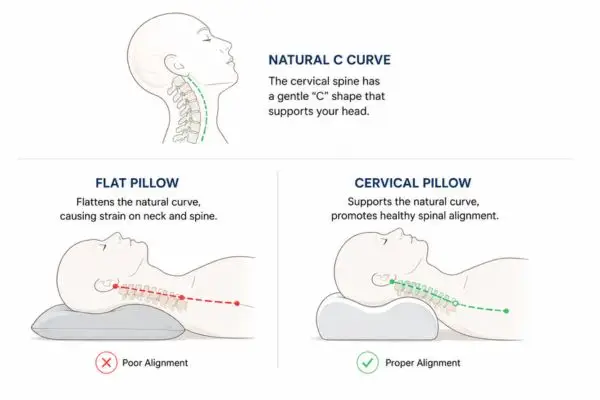
When you lie on your back, your neck has a natural “C” curve.
A flat pillow often flattens that curve.
That’s where cervical pillows come in.
How a Cervical Pillow Works
When I first used one, I noticed something immediately:
My neck felt supported — not just my head.
That’s the key difference in understanding what a cervical pillow is.
The raised portion cradles the neck while the center allows the head to rest slightly lower.
This:
- Reduces muscle tension
- Maintains spinal alignment
- Prevents overextension
- Minimizes side bending
It’s structural support — not just softness.
My First Week Using a Cervical Pillow
Here’s something important most articles barely mention:
There’s an adjustment period.
When I switched, I felt mild soreness for 2–3 nights.
Why?
Because my neck muscles were adapting to a new alignment.
Once my body adjusted, my morning stiffness noticeably decreased.
Understanding what a cervical pillow is includes understanding that transition period.
Who Actually Needs a Cervical Pillow?
Not everyone does.
Here’s who benefits most:
✅ Back sleepers with neck stiffness
✅ Side sleepers with poor alignment
✅ People with forward head posture (“tech neck”)
✅ Office workers
✅ Those with a straightened cervical curve
✅ People whose pain is worse in the morning
If your neck pain improves throughout the day, you may benefit from understanding what a cervical pillow is and testing one.
Cervical Pillow vs Regular Memory Foam Pillow
A regular memory foam pillow:
- Conforms evenly
- Supports the head well
- May lack neck-specific structure
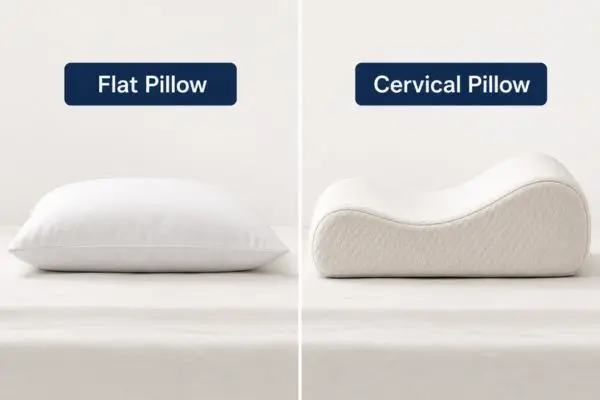
A cervical pillow:
- Separates head and neck support zones
- Encourages natural curve
- Reduces the flattening effect
So when comparing options, asking what a cervical pillow is helps clarify whether you need structure or contour.
Cervical Pillow vs Orthopedic Pillow
Technically, they’re often the same.
Orthopedics is just a broader medical term.
When people search for what a cervical pillow is, they’re often also searching for orthopedic neck support.
Functionally:
They aim to keep the spine neutral.
Mattress Interaction (Most Guides Skip This)
One thing I learned through testing:
Your mattress affects cervical pillow performance.
Soft mattress:
- Shoulders sink
- You may need slightly less neck height.
Firm mattress:
- Shoulders elevated
- You may need more defined neck curve support.
Understanding what a cervical pillow is includes knowing it works best when matched to your mattress firmness.
Sleep Position Matters
Back Sleepers
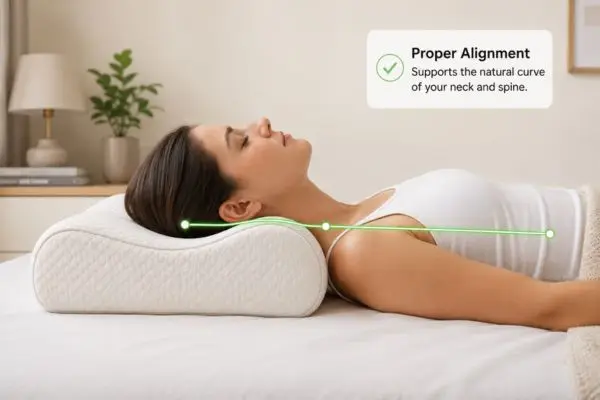
This is where cervical pillows shine.
The neck roll supports the curve while the head rests comfortably.
If you sleep on your back and are asking what a cervical pillow is, it’s likely ideal for you.
Side Sleepers
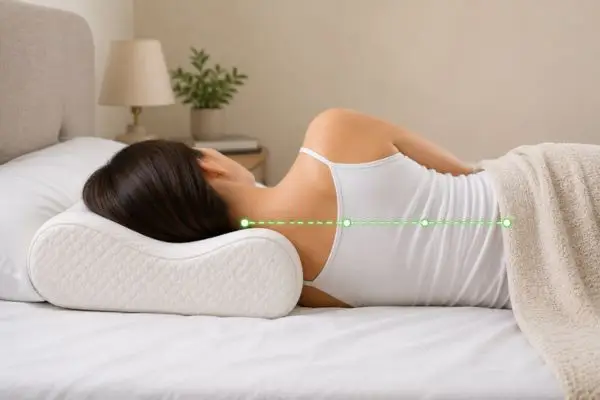
Works well if:
- The pillow is tall enough.
- Neck support reaches shoulder level.
Not all cervical pillows are thick enough for broad shoulders.
Stomach Sleepers
Usually not recommended.
Cervical pillows can force too much extension.
Signs You Might Need One
Ask yourself:
- Is your neck stiff in the morning?
- Do you wake up with base-of-skull headaches?
- Does pain reduce during the day?
- Do you constantly adjust your pillow?
- Does your head tilt forward while sleeping?
If so, exploring what a cervical pillow is may be worthwhile.
Potential Downsides
Being honest:
❌ Takes time to adjust
❌ Not ideal for restless sleepers
❌ Some shapes restrict movement
❌ Not always ideal for very broad shoulders
Understanding what a cervical pillow is also means knowing it’s not perfect for everyone.
How to Use It Properly
Back sleepers:
- Place the neck at the raised portion.
- Head rests in the lower center.
Side sleepers:
- Ensure raised edge fills neck gap.
- Pillow reaches the shoulder.
If it slides up too high, it defeats the purpose.
How Long Do They Last?
Most memory foam cervical pillows last:
- 2–3 years
Latex versions may last longer.
Replace if:
- Permanent indent forms
- Height collapses
- Support weakens
My Final Verdict
So, what is a cervical pillow?
It’s a structured pillow designed to restore and maintain the natural curve of your neck.
Do you need one?
If you wake up sore and your pain improves during the day, it’s absolutely worth trying.
For me, it wasn’t magic — but it significantly reduced morning stiffness once I adapted.
Alignment matters more than plushness.